Description


Showing posts with label agility training. Show all posts

Wednesday, August 7, 2013

Hattiesburg Agility Trial - STCA

Maxie 6 runs, 2 Q's, 1 3rd place, 39 MACH points, 6 videos.
Lucky Lucy:  6 runs, 0 Q's, 5 videos

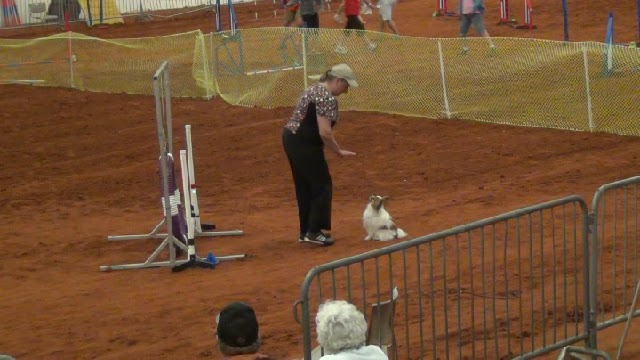
Maxie and me at the start line,
on the red, red dirt of Hattiesburg.
This was a new trial on AKC's calendar, hosted by the AKC afilliated Staffordshire Terrier Club of America on the red red dirt of Hattiesburg.  Dog Gone Fun was hired to run the trial, and they took my BARK bucks in payment, but as no nearby STCA club members could be found to form a Trial Committee, 5 flew in from far parts.  2 from California, 1 from Missouri, and a few others I didn't meet.  They lent a very different flavor to the trial --  loud, friendly, competitive, opinionated, and quite bold handlers of their terriers and pit bulls, who all ran superbly!  They crated near me at ground level in the back hall, so I was privy to some of their almost continuous talk.  No shyness there, and they liked Lucky Lucy.  Their comments were that we southerners are way too uptight, our handling in most cases not very sophisticated.  Their motto:  Fun, Fast, and Fair.  In one kitchen conclave, they said their judges were lots more laid back and entertaining, they handled much more boldly, they focused more on speed and less on Q'ing, and they favored upping the difficulty of AKC courses to prepare competitors for national and international competition.

I objected to that last, explaining that only a handful aspire to compete at the higher levels, that most of us do agility for the health benefits, mental challenge, and structured activities with our dogs.  Several ladies agreed. I suggested the place to make things more complicated is once a dog MACH's, but don't take the recreational aspect of the sport away from the vast majority.  They listened and weren't the least huffy at hearing opinions contrary to their own.

They related that almost all trials out west are held outdoors, as the weather is not so humid and the summer heat much easier to tolerate, everyone brings canopies against heat and rain, and there are tons of matches and trials to attend almost every weekend.  They hinted that outdoors, dogs tend to be more excited about the sport.  Is that why Lucky does so well at our field, so poorly in the arenas?  I hadn't thought of it, but we NEVER practice indoors!

OUR PERFORMANCE:


Maxie's 1st run was splendid, a solid Standard Q with 20 MACH points.  A few wide turns cost us placement. That felt great!   His second run was clean but he broke his start line stay (not a fault but very rare) and ran 2 seconds over course time.  Why so slow?  3 runs were very close to Q's, 1 run he veered right and did a tunnel suck while I was going left.  Another run he knocked a bar.  Then one run we did the "Walk Of Shame" off the course, where he smelled something mid-course and wouldn't stop circling and sniffing, and would not let me pick him up.  We got whistled off, of course.  I finally commanded a "Sit", and he sat.  Several other dogs sniffed and NQ'd in the same general area.  I marched straight to his crate and denied him a treat, and ignored him for awhile (a first for us), but I don't think he related this punishment to his behavior.  The best part of all this, for me, is I didn't feel the least bit embarrassed!  Last year I'd have been mortified.

Lucky had 3 clean runs, alas all over course time, and the other 3 she had one mistake each - one weave pop-out, another caused by my bout of vertigo at a planned front cross so I just stood there as the room spun around and she took the jump straight ahead, another a badly placed rear cross.  This last run was her only one with seconds to spare.  She mostly walked the courses.

"BEHIND" command.  One of the STCA gals, running a fast 20" terrier, did an amazing maneuver that caught everybody's attention on Saturday and some of the small dog handlers, walking the course afterwards, crowded around the jumps to discuss it and wonder if we would dare try it.  I was sorely tempted, but with a QQ on the line and no prior practice, I chickened out.  I include the map below. 


It's a "ketchker", some said, but one which I found easier to comprehend than most. More elegant than making a 260 turn, and much faster, the STCA lady showed me how she taught that maneuver at home as a "behind" command.  I'm setting it up in my yard this week, from both left and right directions.

At the vendors, I finally fitted Pepper with a sturdy red harness, and a matching black leash.  Immediately upon attaching this leash to either his collar or harness, he began calmly walking by my side on a loose leash.  Not one bit of pulling, the whole rest of the weekend.  Go figure!  Is he growing up or is it that he finally feels properly pampered?

It was a pleasant RV vacation.  All went perfect.   Nothing forgotten.  No injuries.  No mishaps. Weather overcast and not too hot, nothing like last year's tornado/hail storm.  There was space between the isolated rain showers to pack without getting wet.  A few visitors - Ken, Karen and Christina.  Avoiding the 4th of July parties, I enjoyed my yard and listened to an audio book, The Promised Land, for hours with my new Bluetooth speaker -- my version of celebrating the 4th, because the book is about a Russian Jewish family who emigrated to America in the 1890's and compared their new-found freedoms with the oppressive social, political, poverty and religious conditions in their native village.  We do have it good! While listening hands free, I made a few more improvements in my packing.  cut down significantly on road rattles by placing damp sponges behind the dog crate doors and stove grate.  I learned that Maxie and Pepper love to lie in the red wagon on the porch and chew their twizzle sticks in isolation from Lucky.  We were all completely relaxed.  I worked on training them not to bark so much at passersby, popping a damp wash cloth against the fence and saying Aah, which startled them!  After a few times, they settled down very well.

Going to Hattiesburg and back, generator running, takes 3/4ths tank of gas, i.e., 45 gallons, i.e. $148.  Yikes!  Including running fees for 2 dogs (entered only in MS and MJ) and RV spot for 3 nights, this trial cost me +/- $450.  Sounds high, but imagine those who have several dogs entered, run them in 4 events daily, stay in hotels, eat out, come from much further away, and whose SUV's don't get much better mileage than my RV!

GOALS MET/GOALS SET:

Maxie to surpass 750 MACH points, accomplished.
Maxie one QQ, not met.
Maxie, run his weaves.  Did this 3 out of 6 times.
None of my goals for Lucky were met.  No Q's.  No fast weaves.  Only 1 run under course time.  But I can say a few good things.  She didn't pause on top of the A-frame, didn't miss any of her contacts, and didn't seem overly stressed.

So my goals remain the same:  QQ's, running weaves, faster times, and better handling.  Do what I can to lengthen Maxie's stride, which seems to be getting shorter and shorter.  And now, getting to the bottom of this vertigo and having the courage to deal with my worsening vision.

I delayed this post a long time waiting to finish my video composites, but I still haven't done them.  Not much of a thrill watching a long string of NQ's!  Besides, doing Librivox recordings and my garden have kept me plenty busy, plus an upcoming post on the produce we've enjoyed.

Upwards and onward!

Wednesday, December 5, 2012

Blog Action Day #4 - BACKYARD TRAINING

Today, December 5th, is our 4th Blog Action Day, sharing ideas with other agility trainers on things they do at home to train their dogs.  Links to all the other bloggers posts are listed here.  My favorite take-aways are here.

**************************
I didn't think I'd have much to say on this topic, but once I got going I couldn't stop. I've tried to cull my material to things new and different from what other handlers might have to say, except for some background introduction on how often I train. Here goes: 

I tell beginner students:  "You can't learn agility in one hour a week".  And that's the truth! 

Yet each of my dogs attends class only 1 hour a week, gets maybe 4 or 5 turns, and I attend 1 or 2 seminars a year, and go to 7 or 8 trials per year where Maxie and Lucky Lucy go in the ring two times per day, XS and XJ for less than a minute each time.  There are hardly any matches in our area. That's all the agility we would get unless we practice on our own.

Our dog club has a wonderful Field Use program where members can pay $50/year and have 24/7 access to our fenced field, which is lighted all night and 2-3 courses, plus practice drills, are usually set up with competition quality equipment. The club cuts the grass. It's an amazing bargain, but still you have to drive there, you're on 2 acres eeriely alone, and it's not as convenient as your own back yard.  Plus neither my dogs nor I like hot or cold weather (above 85, below 50), so we pretty much only get out in spring and fall. It's amazing how well we do with so little practice.

Finding The Right Class: I can't always find a class that fits my dog's needs. This was true with Lucky Lucy, and now with Pepper at Beginners level. In Intro class he had no hesitation doing the obstacles, but the instructor had us working off leash right away, thus Pepper would do the short sequence (jump-tunnel-jump, jump/see saw/jump, etc.) then he'd run away exploring, visiting, sniffing. Papillons are very spunky that way, and hard to catch. Before working off leash, I think he should have learned to stay with me and run alongside me taking obstacles in class the way Maxie did (same teacher, but 4 years ago). We got promoted out of the class without enough handler focus. Now I have to fix this myself at home.  No further agility training until we resolve this issue.

Resources:  At home, I follow a few agility blogs or journals.  I've read some agility books.   I watch numerous YouTube videos. I appreciate every piece of input and try out some of it. But when I step away from that material, I don't always remember it like they said it, and I end up doing things my own way.  In fact, I like making up my own exercises. To me, it's not all about training for the ring.  I like to play with my dogs, see what I can get them to do, explore their intelligence (and mine), work out performance issues, invent exercises, and track improvements. 

FOUNDATION SKILLS:  I've long said, there's a lot more to agility than performing obstacles. Most of us are woefully undertrained in foundation skills.  My newest puppy isn't fully bonded with me -- he's more independant than the others.  I have bond-building to do.

Indoor stuff:
I use feeding time, loading up in the car, sitting for leash attachments, crate games, no begging at mealtimes, jumping into my arms, standing for exam, sitting for grooming, waiting until their name is called before eating or leaving the room, etc., -- all good training opportunities that recur daily, sometimes hourly, that teach impulse control, focus, and discipline.  We do the routine "parlor tricks" that wow company, are fun, and earn the dogs several mid-day snacks.  They all apply to agility, but you have to keep this up.  If you go slack, the behavior weakens.  So we do it a lot.  My wardrobe has changed to shirts, dresses and pants with pockets.  I keep jars of treats and clickers everywhere I sit.

Outdoor stuff:
I have a large fenced yard, fully equipped, and set up some Backyard Dog exercises, boxes, double boxes, and pinwheels, and actually number and do them now and then.  I set up and practice some of Steve's Jump Wraps and other handling exercises.  I also run obstacles that are scattered about the yard, in un-numbered fashion, asking for tight wraps, sending, leaving, etc., whenever I see the dogs begging to do tricks.  I allow myself to be spontaneous sometimes.  It's exhilerating to interact freely with my pooches, without fear that I'll forget what comes next or that they will err.

Last year a truck ran down our old mailbox on the highway.  We replaced it, I banged out the dents in the old one and put it on a post in the middle of the agility yard -- a handy dry place to keep nested numbers away from ants, tug toys, balls, a plastic tub of dry treats so I don't have to run back inside for training aides every time I get a yen to train my dogs.  The dogs will go sit by it when they want to play. It's cute!

I use Clean Run's Course Designer to draw parts of courses I find challenging and exercises I make up. Keeping a record of exercises I've worked on is part of why I keep this blog. I'm still refining my labels (key words) so one day I can find them all under Training Exercises.  When I go back and read the problems I was working through 2 years ago, I can see how far I've come in my understanding. I find the process fascinating, and encouraging. And sometimes embarassing. If my blog was just about accuracy, I would delete or change these posts.  But I've decided my blog isn't just about accuracy.  It's the story of my development as a newbie handler, and all the struggles, heartaches and perseverance it takes to stay in the game.

I encourage handlers to go through some raw experiences of making up challenges from scratch, to identify one small problem and "think dog" to resolve it,  to "own" the training process, not just follow the finished material of other handlers. When someone else hands you a solution, you tend to take it for granted that the exercise they devised is "simple", "true", and "obvious", not realizing how many steps it took for them to work out the kinks. And their solution might not be a universal fix that applies to your dog.  If "guessing games" are good for our dogs, they are just as good for us, and for the same reasons.  They keep you agile, and engaged.

ARMCHAIR TRAINING:

Distance Handling:  I've been injured so often (sciatica, hip bursitis, strained knee, pulled calf muscle) the past 4 years, I'm intrigued with the concept of training from a chair.  Also, I'm such a slow runner, I feel the need to build distance handling skills. There's a lady (Kathy somebody) who competes along the Gulf Coast area who can't run at all, walks in the ring with a cane, dragging one foot behind her, and directs her fast border collie around the course, moving her shoulders too and fro and taking a few steps along what I call the "Handler's Corridor".  It's amazing to watch her walk the course and plan her strategy so differently from the rest of us, and her dog often Q's.  She shows that extreme distance handling is possible.  I told her once, "I'd love to watch you train.  If you'd like, I'll help you write your story".  She looked at me like I was crazy then said "I haven't trained a puppy in years, but it starts out from the very beginning. I'm not sure I remember how I did it."  She did not refer me to a book, a system, or a trainer.  Apparently she invented her own system!

Handler's Corridor vs Game Of Chase:  I often look at course maps and try to identify the "Handler's Corridor", the minimal space a handler needs to move through to support every obstacle at a distance.  It's a real fun way to look at any sequence (not at a trial when a Q is on the line, but at home).  One day I'll blog about the Handler's Corridor.  It is the exact antithesis to my most recent understanding of agility being a "game of chase" where handler runs fast, supports each obstacle closely, and dog gleefully chases the handler along.  I got this latest insight from researching 2012's top ranked AKC agility dog, an 8" Papillon named Tigger with 35 MACHs and over 55,000 MACH points, and searching on YouTube for videos of his runs.  You can astound yourself by reading my Tigger report here. Watch the video links at the bottom.  I've since discovered from Susan Garrett's blog that today's world champion teams are playing agility as a game of chase.  View a few of these videos here, and gasp!


Jumping Practice From My Chair: I have a 25' x 25' vegetable garden in my training yard, with a 2' picket fence all around it.  I discovered I could toss a ball into the garden, Lucky jumps in to fetch it, then jumps out and brings it back to me.  Here's a short video of this exercise, showing her lovely extension and powerful, accurate jumping style, easy to see because of her short hair.


Oh my, how she loves this game, and it keeps her in shape!  This has come in handy when an injury has kept me from exercising her, or when my husband comes home from work too exhausted to tug with her.  I have a 30" high wrought iron fence dividing my front yard, too, and she jumps that back and forth several times a day as well.  She has a natural eye for judging height and distance, and at trials, she has only ever knocked one bar that I can remember.  The higher the jump, the better she likes it.

I train from my chair indoors too. Here's a recent blog post I did on Hassock Drills, which really taxes their brains and requires focus, coordination and cooperation. Great for developing body awareness.

Distance handling with tunnel:  My latest distance exercise is to send either Maxie, Lucky or Pepper to my 9' tunnel from my porch chair, starting about 6' away. My goal is to have the tunnel at least 40' away, and use minimal motion.  The learning process for them and me is unfolding slowly.  There are lots of issues to work out.  I'm documenting the steps on video to post someday on this blog.  I'm calling it: "Evolution Of A Training Exercise".

Relays:   I don't know anybody else who does relays, but they are loads of fun.  Here's a video I posted last year of Maxie and Lucky doing Weave Relays.  And another of Pepper at 4 months old doing his first Tunnel Relays.  (His nicknames back then were Winnie and Honey Bear).

Weave Poles:   Maxie did channel weaves in class but never got it.  He was actually banished from Advanced Beginners class for 3 months until he could do 6 weave poles successfully.  It wasn't until I put peanut butter on a long wooden spoon to lure him through at home, that he got it.  I did Susan Garrett's 2x2's with Lucky because she fetches and tugs, and she's got it.  But I'm trying a new way with Pepper - my own method. Here's the diagram I drew before I even tried it on him and so far my thought experiment is working pretty well, though it's hard to throw the treat in exactly the right place.  Another evolutionary process.


I don't claim this works better than any other method.  But it illustrates my point.  I like inventing my own exercises, observing the results.  I'm a pioneer at heart.

See Saw Entries:  I have my own method for that too.  I don't ever want my dogs entering the see saw from the side.  From the beginning, I put wings on either side of the low end.  Dog has to run around the wing and enter head on.  After awhile this becomes routine.  Wings turn into flower pots.  Pots disappear.  Max and Lucky both have great see saw entries - always straight on, from any angle.  They translate this skill to dog walk and A-frame entries too, all by themselves.

See Saw Exits:  I have my own method for that, too.  I am always surprised how many dogs fly off the see saw at trials. I never want to see that or a bail off.  Never.  They can be dangerous.  I also marvel at dogs who creep across the see-saw, or won't run out to the end.  From day one, I require a 4 on contact, a halt, and wait for release before leaving.  I encourage a lowered head to lower my little papillons' center of gravity in preparation for the bounce, and get it by delivering the treat at board level, 2" from the end of the board, never up in the air like most everyone else does.  Alas, treating like this requires bending over.  The only time I release from the see-saw immediately is at a trial, which they do with no problem.

Making up your own exercises is fun.  It becomes a necessity when nobody has a solution to your problem.  Following other people's exercises, or making up your own, either way, requires you to become a better observer.  Is it working?  If not, you must be willing to swallow your pride, abandon your bright idea, and try something else.  That gets your humility up, your brain cells jumping!

Treadmill Training:  I've long known that agility requires running, but long excused myself that I don't know how to run, don't even have the muscles in my legs for running, they attrophied in my 20's, and distance handling is possible.  I'm great at excuses.   At 66, I've never in my life had to run anywhere -- except maybe to the bathroom once in a blue moon.  I've prayed for a running coach, not yet forthcoming, not my fault.  I've yearned for long legs.  What I've not done until recently is pull my treadmill out of the corner, dust it off, and begun using it 30 minutes a day to walk at faster and faster speeds.  Get my heart rate up.  Increase my stride.  I was finally inspired to do this at a recent agility seminar where the instructor pointed out how poorly I run, then informed the whole class how poorly we all run (like old ladies), and that she treadmills at least 30 minutes a day, raising and lowering her speed to simulate the sprint of an agility run.  And then the next weekend, at a trial I was attending, she MACHIIed her dog!  She's not a thin gal, but moved along quite fast. Faster than her YouTube videos of yesteryear.  I was inspired by her increased skills! 

Training Partners/Students:  My biggest stumbling block in practicing is that I'm more motivated to train when someone trains with me. I'm more likely to spiff up the yard, set sequences, clean/repair equipment, think through problems, run well, when someone is coming over. I've never been able to acquire a steady training partner, though.

Videos: Of course, taking videos of trial runs and training sessions and studying them, is a must!  If you can't see yourself moving, it's like a ballet dancer trying to learn graceful postures without a mirror.  Agility is as much about training ourselves to handle as training our dogs.  I've heard people say they can't stand to watch themselves in videos.  I know, I've gotten almost sick watching my arms flap around like a wounded bird, me yelling the name of every obstacle as though my dogs were deaf, causing faults by my confusion, poor timing or clumsy actions.  But I learn more from watching my and other people's videos as from any other teacher or training tool.  Setting up and videoing lessons for this blog is almost as motivating as having a training partner -- I feel like I'm sharing the experience with someone else.  It pushes me toward improvement in a way nothing else can do.

Well, there are a hundred variations on each theme.  I've read all the other posts, and here are my favorite take-aways.

Upwards and onward!
Wednesday, November 28, 2012

Agility Seminar with Tanya Lee - My Notes

Our club's beautiful agility field, on a cool November day, perfect for a seminar.
Our local dog club hosted its 2nd agility seminar of 2012 two weekends back, it so happens, on my birthday.  We brought in Tanya Lee from north Louisiana, who competes with her border collie, Boost, and serves as Trial Secretary for the Ouichita Valley Dog Training Club out of Monroe, LA.

She sent out requests for what we wanted to cover, I replied FOUNDATION WORK, and that's just what we got.  I was well pleased.  Below are my class notes and sketches.

Below, D stands for Dog, H stands for Handler.

FRIDAY:
I brought Pepper for the Friday Beginners class from 2-4:30.  Content as follows:

Impulse Control:
Should be 80% of training until dog is calm and in control, 20% agility.  Best way to teach this is Susan Garrett's Crate Games and Leslie McDevitt's Control Unleashed DVDs.  Everyone should have these. Your home life is the indicator of what will happen in agility.  Start training at home.

To perfect Impulse Control, and get your dog paying attention to YOU, she placed a dog on the table with handler in front, then looked for things like "front paws still, ears forward, mouth open, shoulders relaxed, and dog's eyes focused on handler".  CLICK/TREAT for one behavior, then another, then a combination of 2 or 3. When all are lined up, then JACKPOT.  She did this for about 10 minutes with the same dog, increasing the distractions little by little.

Obstacle Focus:
D and H at take off side of a jump, D sits in front, H off to the side.  Every time D looks at jump, CLICK/TREAT.  H moves in various places, including landing side of jump, and repeats.  Never release D to take an obstacle until D is looking at it.  Similarly, place D before tunnel entrance, handler to the side.  Every time D turns their head toward the tunnel entrance, CLICK TREAT.  Handler eventually increases distance from D, and when D looks at tunnel entrance, release and run the sequence.

Never release using D's name.  "Pepper, tunnel" is wrong.  When you call their name, they look at you instead of obstacle. Calling their name should mean "look at me, come to me".


SATURDAY 8-12/SUNDAY 7:30-11
I alternated Maxie and Lucky during both Saturday and Sunday classes, which was not the best idea as skills were built upon one another and neither dog got the full compliment.  But it worked out OK because Tanya's main focus was on training the handlers.  I got the usual advice:
  • I don't run, am slowing my dogs down, etc.  Get on the treadmill every day and sprint.
  • My arms are too high.  Hold them no higher than the dog's jump
  • Point to the path, not the obstacle.
  • Should not call name of obstacle if it is in D's path.  They should know to take what is in front of them unless you call them off.
  • I don't have the courses completely memorized ahead of time so I hesitate.  She recommends studying the course maps thoroughly before walking the course. It's imperative that by the time I run my dog, I need to be able to not "think", just "do".  Figuring things out as I go along just confuses the dog! 

Crosses:
  • Blind crosses should be done as far ahead of D as possible and while D is looking the other way.
  • Rears as far behind D as possible.
  • Fronts ON the dog's running line, not way past it and as far forward as possible. Timing is important.

We practiced blind crosses and ketchker maneuvers on each and every drill.  She explained when these maneuvers are the very best moves to make in certain situations.
1. Turning into D always signals collection.  Pull through, ketchker. Ketchker lets you signal collection while at the same time keeping D on same side. It is a reverse post turn. It says "stay tight to me".
2.  Turning away from D always signals extension.  Post turn. 
3. Collection become more important for larger, faster dogs than for small dogs.


Commitment Point: It's important to support the obstacle until D commits to it, then LEAVE.  D's commitment point should be long before D takes off.  Learn to recognize it, then get going to your next point.  Commitment Point is different for each dog.

Zone Of Information:  D should definitely know which obstacle they are going to next BEFORE they take the current obstacle. This tells them how to gauge themselves over the current obstacle (extension, collection, lead change). Do you know when you tell D what the next obstacle is going to be?  Is it too soon?  Too late?  When is the proper zone of information for your D?  Ideally, you should name the next obstacle as soon as they commit to the previous obstacle.

LEAVING:  Leaving is different from a send, because YOU are leaving.  Taught with target work.  Dog's job is to take the obstacle you indicate no matter what you are doing.  Train this by having them "drive to a target" over an obstacle, such as food, while you are going the opposite way.  Here's a diagram:


Obstacle Commitment:
D should take whatever is between you and them without instruction.  Here's an exercise to develop this skill.  Work both sides and using different equipment.


Jump Slices:
Teach D to take jumps from every angle.  As the slices get more and more angled, D gets closer and closer to the jump cups.  It's important the jump cups aren't sharp or jagged, which could result in injury.


NOTES:
  • Everyone should do lots of pinwheel work.
  • Dogs read your feet more than your upper body.  Be mindful where your feet are pointing.  Face the path, not the obstacle.
  • Hold your hand low, point to the bar not over it.
  • Use verbals when your body disagrees with what you want.
  • In training, use a clicker.
  • Noel got some ultra light tennies at Payless called Champion Light, on sale for $19
  • Tanya recommends New Balance Minimum shoes.  Helps you run lighter and on your toes.  She does not recommend heel to toe running, nor heavy soled shoes.
  • Tanya NEVER runs full courses, except at trials.  She works on foundation skills every day.  Foundation.  Foundation.  Foundation. Best way to kill your dog's enthusiasm for agility is to consistently make them run 20 obstacles before you pay them.
Well, that's all I can remember.  My job was to set up and keep the portable PA system working, which I did.  Sunday, I made a wonderful discovery.  Rather than stretch speaker wire out over the ground and move the equipment table to different areas of the field where we were working, I put the entire system in the wagon, including the speaker, and wheeled it around to wherever we wanted.  No more hauling stuff.  No more wires stretched out.  It made my job so much easier. So simple. Why didn't I think of that 2 years ago?

I sent Tanya a link to this page, and here's what she wrote back:

Wow....extremely comprehensive analysis of what was covered.  Great recap and I hope you share with others in your club.  Most excellent job!

I sent the link to Georgie, our seminar organizer, for distribution and she sent it out for Christmas.  Cool!

Upwards and onward!

Saturday, October 6, 2012

Tunnel Jump Relays

Yesteday I set up my tripod and took video of Pepper and Maxie doing Tunnel Jump Relays --  comparing the first attempts of a puppy with my seasoned agility dog.  Audrey came along as a second trainer.  This was Pepper's first attempt, Audrey's first crack at dog training, and Maxie hasn't done this in over a year.  Pepper's performance was sporadic. 

The most imortant things I learned are that
  • Pepper values boiled chicken liver treats more than gizzard treats.  After I switched to liver treats, he came to me more readily.  I had given Audrey the liver treats because they break up more easily, and because I can put the gizzard treats in my mouth (I love gizzards).
  • Pepper will have no trouble jumping12", though we'll continue to practice mostly 8" until he's older.
  • Pepper needs a lot of flatwork at home before doing much sequencing.
  • Maxie has forgotten how to do the exercise spontaneously,without any direction like he used to do.  We'll have to work on that.
If I hadn't been so anxious to capture this relay on video in the short time allotted, I would have backchained the exercise first -- straight tunnel, slightly curved tunnel, deeply curved tunnel, add one jump, then the second jump.  Pepper started doing straight and slightly curved tunnel relays at about 4 months.  But I was in a hurry to assess Pepper's ability to sequence before Beginners class begins next week.  My bad. After practicing a few more weeks, I'll take another video, hopefully with better results. It's a process.

Here's the video, about 8 minutes.  The whole exercise took about 15 minutes with both dogs.  The weather was low 80's, nice and cool, and mostly in the shade.


Next I'll post the Dog Walk Relays we did the same day after a brief rest.

Upwards and onward!

Tuesday, October 2, 2012

A Study of Weave Performance - Front View

It takes a dog between 3.5 - 6 seconds to run through the weaves, too fast to notice all the fine details of their footwork, especially if you are the handler/trainer. So, last year in Lake Charles I took video snippets of numerous Excellent level dogs taking the weaves at a trial, all running towards me.  I finally got around to compiling them into a slo-mo video to better understand how different dogs take the weaves, how a lack of consistent footwork slows them down and leads to pop-outs, and how even high achieving dogs who complete the weaves are sometimes inconsistent. 

Here's the 6 minute video of 26 Excellent Class dogs in a T2B run, slowed down to 40-50% speed.


Do you know how your dog weaves? 

Several things I noticed:
  • Almost all dogs have the same rear foot action - a two foot hop, regardless what the front feet are doing.
  • A few large one-stepping dogs only put down one back foot also, or barely touch the other foot down.
  • All dogs push out of the last weave with 2 front feet.
  • All dogs head check their handler as they leave the last space unless the handler is already ahead of them.
  • Some dogs push the poles with their head or shoulders, to straighten their line, which probably improves their speed.  They leave the poles all aquiver.  Other dogs don't touch the poles.
Inconsistencies include:
  • Leading into the space with the outside foot sometimes, other times with the inside foot.
  • Both front feet land simultaneous sometimes, other times it's a stutter landing.
  • One footing it sometimes, two footing it other times.
  • One footing it on one side, two footing it on the other side, consistently.
  • Even in consistent two steppers, they sometimes land on the outside foot first and the inside foot other times, or always land on the same foot first no matter which side of the weaves they are on.
  • Some dogs combine all of the above within a single pass through the weaves.
  • An inordinate number of dogs pop out at the 10th weave.  Why is that?
I want to learn how to improve footwork consistency in the dogs I train. Let me know what you think.  I invite discussion.  I've heard various things from various trainers, including
  • Always practice on channel weaves except a week before a trial.
  • Trainers close the channel weaves too quickly, before their dogs commit the performance to muscle memory.
  • I don't care how my dogs weave, as long as they know they have to get through them.
Two stepping and one-stepping are both correct styles in my view.  Each dog will do the style that suits them.  And yet, we should be able to improve consistency and the answer lies in back-chaining and baby steps.  Hitting solid entries.  Susan Garrett's 2 x 2's is one way.  (Our club has a set.  Hardly anybody uses them.  It's hard to teach a class with multiple students on the 2 x 2's.)

Last year I posted a still shot study of the various front foot action, plus a slo-mo video of rear foot weave action.  You can view that study at this post.

Upwards and onward!

Saturday, September 15, 2012

Blog Action Day - "What Makes A Good Coach/Instructor"

Due to Hurricane Isaac cleanup issues, I missed the September 5th deadline for this 3rd Blog Action Day topic, but I want to write on the topic anyway.  I also posted my Blog Action Day Takeaways here (the favorite parts of the other essays I read).  My own thoughts go thus:

There are no great atheletes out there without a coach.

Watching any sport on TV, it becomes obvious that coaches are necessary. . . . . every athelete has a coach on the sidelines, watching every move, encouraging, rising and falling with the athelete's rise and fall. We see how every olympic figure skater or gymnast without exception gets the pep talk before going into the ring, and afterwards. Every ball game has a coach shouting orders, making notes, giving pep talks.

What makes the athelete great is, first of all, their willingness to be coached throughout their career. If you are unwilling to be coached, you'll never get far.

Finding/being the right coach is another matter.  The great coaches I see out there are not themselves always able to perform the skill. The olympic figure skater's coach is often portly, never in skates, the ballet teachers aren't at the bar practicing, football coaches aren't out there getting tackled.  The coach, it seems, just understands the sequence of steps required to advance, and makes sure your training includes every foundational element you need.  They see things from the sidelines you can't see. They do their best to leave nothing out. A great coach has time to focus on the details of YOUR training, not being caught up in theirs.  The great coach encourages you through multiple failures, places rewards along the way, has an eye for small improvements, builds upon your strengths, works around your weaknesses, and helps you set realistic goals. It's an art form. The great coach understands that the closer you approach excellence, the more sophisticated your skills, the closer to the edge of perfection you strive to get, the easier it will be to fail. The great coach embraces failure as part of the program, and is there for you to try on another day.

It takes another pair of eyes to look objectively at what you are doing. Unfortunately, finding someone willing to watch you that closely, whose opinion you really trust, for that long, isn't easy. It doesn't always require a close personal bond between coach and student.  The coach just needs to know what they are doing, inspire effort, and inspire trust.  Inspiration is 50% of the learning battle.

A teacher all my adult life, my teaching philosophy has drawn more from my many bad, uninspiring teachers than from the very few teachers I consider "excellent". Teaching/coaching in an inspiring way is so extremely rare.

We've all had these experiences in grade school.  The teacher
  • ignores you when you raise your hand with the answer, and calls on you when your mind is blank.  What's up with this?  Do they purposely try to embarass you?
  • has favorites who get all the acccolades and attention, while the other students are ignored.
  • lets some kids slide while being hard on others for the same thing.
  • is unprepared, doesn't know what they are talking about.
  • makes their subject so boring you don't want to learn it.
  • sets the pace by the slowest students, boring the advanced students to death.
  • constantly praises the fastest students, making the slower students feel dumb.
  • takes offense at questions, dislikes creativity, fails to recognize innovation, etc.
Let's face it.  Our whole A-F school system encourages our teachers to look for and punish errors, not reward what's right.  What if, instead of marking papers down from 100, we changed their point of view and marked papers up from 0.  70% right instead of 30% wrong.  What if students just got to repeat the failed parts of the test until they aced it, and teachers used their students' failing marks as clues where to teach to.  On my agility NQ's, for example, I usually get 18 out of 19 right.  Once I learned to feel good about how much I get right, I felt more empowered and encouraged to isolate and fix the errors. 

I've pretty much done my best to forget school, but there are indelible memories that stand out, including both good and bad ones:

Praise: My 5th grade civics teacher changed my self-concept within about 5 minutes when towards the end of class, in an idle moment, he played a little word game with the class. He stuck his hand in his pocket and said, "If I say I ain't got no money in my pocket, do I have money in my pocket or not?" Everyone in class insisted he didn't, except me. He finally acknowledged me as the only one who got it right, and made me stand up to explain the double negative, that NOT having NO MONEY, meant he did have money. I finally felt I had some brains. In 5 minutes a teacher can change your self-concept.

Enthusiasm:  My 7th grade geometry teacher was short and dumpy with horn rim glasses and a high pitched voice.  30 kids in her class, and no assistant.  The 2 bad boys sitting at the back made such fun of her, one of them threw an eraser that hit her in the back of the head one day, leaving a dust of chalk in her dark mop of thick fuzzy hair.  She was so busy at the chalkboard extolling the virtues of geometry, she didn't even notice!  "Geometry is everywhere", she exclaimed with her arms open wide on our first day, and set us a homework assignment of counting how many triangles, rectangles and circles we could identify in our houses.  I had never really noticed shapes before.  I was totally hooked on observing my world from then on.  Proving theorums was a challenge, but if we got it wrong, she didn't give an F.  She said go back and reread the chapter, see me after class, until you get it right.  She wanted us all to pass.  I still have my geometry book, and refer to it when I'm arranging furniture, building equipment, planning my garden space, or anything else.  She wasn't personable, sweet or affectionate, but she opened my brain up to a whole new level of awareness.  Her enthusiasm conveyed to me the thrill of figuring things out, and I felt more alive, empowered, amazed, intrigued, and anxious to learn more. This feeling has never left me.  That's what a great teacher does!

Unfairness: My 7th grade biology teacher was Adonnis to me. I worshipped him. I applied myself to every lesson and made A's and B+s for him. That is, until he brought a snake to school and told us we'd get an F on our mid-term exam if we didn't hold the snake. As he approached my desk with the snake writhing in his hand, my throat closed up, I froze in fear, my brain imploded and I ran from my desk sobbing. He shook his head in disapproval, skipped me without further acknowledgment (ever), I did indeed get an F, and I loathed him from that day forward. I made C's the rest of the year. To this day I love biology, but hate snakes, and hate him for shutting me down and devising such an inappropriate test.

Skill-Building and Pride Building: My 4 years of Honors English in High School introduced me to classical literature, writing, diagraming sentences, studying style, devices, etc.  The 2 teachers were hard on us.   Every punctuation or spelling error lowered our grade point.  We learned to pay attention real quickly because anyone who dropped below a C average was bumped out of Honors and someone else given your spot.  It was devilishly hard and there was lots of homework but we didn't want to get bumped -- it was an honor to be in there.  These teachers, while curt, stuck up, opinionated, and sometimes playing favorites, awakened a sense of pride in us of being intelligent, captains of our fate, masters of our souls, responsible for civilization.  They made life seem extremely precious and important. On the last day of High School, the last words Ms. Gomez spoke to us was "Good Bye, Good Luck, and remember the world is your oyster, make of it what you will".  48 years later, I'm still pondering what she meant by these words.

Communications: My11th grade chemistry teacher was so dry, dull and boring, I flunked the course. My only report card F in high school. Of course my parents blamed me for not applying myself but I still maintain, it was his fault entirely. Chemistry is a fascinating topic to me to this day, he was simply unintelligible.  His communications skills were so poor, his demeanor so suspicious of everyone, he was totally unsuited to teaching. 

Negativity/Defensiveness:  What is it with teachers who say, on the first day of class, that "Most of you are going to flunk this course."  I have had several college instructors tell their classes that.  They should be immediately fired.

Now on to my thoughts on agility teachers/coaches.

In agility training:
I want my teacher to create a comfortable environment where I feel safe and welcome.  I don't want be frowned at, ignored, snubbed, intimidated, yelled at, barked at, or for my teacher to waste my time.  I want to feel like the teacher knows I'm there and is glad to see me and my dog. I don't want to hear how much the teacher loves somebody else's dog or breed, or "not liking little dogs, big dogs, long-haired dogs, or whatever". I don't want my one hour class or all day seminar to consist mostly of sitting around waiting for my turn.  Get people lined up and keep the class moving. When it is my turn, I want my teacher to pay attention to me, not be off chatting with someone else.  I don't want to be interrupted during my attempt at a sequence, rather, watch me, comment on what I did, praise what's right, suggest improvements, and let me try again.  Give me pointers, but don't insult or deride me in front of my classmates.  Don't praise the star pupil every time and give them multiple turns, then say nothing to others and cut their turn short.  Likewise, don't spend all your time with the weakest/slowest student. This happens over and over. Keep the class moving.

If you're teaching a seminar, have a wireless lapel mike and PA system, so everyone on the field can hear you. Then, even while you're out on the field coaching one particular student, students on the sideline can benefit from your coaching.  It will also save your voice.  Our club has our own, but I think seminar instructors would do well to invest in this equipment.  So would judges in AKC's FAST class. It should be mandatory equipment. No telling how many times the scribe misses the judge's call. A decent system with a rechargeable battery runs around $2-300.

Ask me what my goals are.  Pick up on the nuances.  Teach me in baby steps.  Push when you see an opening, not whenever something pops into your head.  Be fair.  I know, it's a whole lot to ask of any coach/teacher, but that's what a teacher is.

I've noticed in my preschool teaching, some kids automatically present roadblocks to learning.  The can't focus, don't take even the smallest suggestions well, are too sensitive, refuse to be coached, come at everything with an "I already know how to do this so I don't need to listen to you", or "it's too hard I'll never get it right".  Whether cocky or downtrodden, the class clown or someone with an enormous chip on their shoulder, these extremes are among the hardest to teach, and both lag behind in their progress.  That's not the coach's fault, and it's hard to figure the causes because these students don't always have the biggest life challenges.  I've come to think learning attitude is partially programmed into one's DNA.

In any case, some teachers are best suited to working with gifted/talented students, older students, young children, others work better with mentally, emotionally or physically challenged kids. A great coach for one student can be a lousy coach for someone else. Also, a novice student should not expect to command the time and attention of a world class coach.  There not being too many experts at the top, the trickle down system is essential and works.  Find someone who knows more than you do.  When you learn to their level, move up.  In every case, I believe it is each teachers' responsibility to position themselves to work with the right students based on their own gifts, or be willing and able to change their tactics depending on who they are working with. Teachers unsuited to their students can do a lot of damage.

On the other hand, eventually, sadly, the student must also inspire the coach. . . . . the way our dogs inspire us. Another Blog Action Day subject might be "What Makes A Good Student."

Upwards and onward!

Friday, May 4, 2012

Components Training

Going through a rough patch these past 2 months, I haven't been blogging much.  Then Susan Garrett's Components Training blog post came along, and suddenly I feel I have a better handle on how to get through all of this.  Agility Training is like that.  It offers many lessons that can be applied to life.  Here's a short synopsis of what's going on with me:
  • My cataract surgery did not go well last month and I'm dealing with vertigo, fear and  disappointment. I had such high hopes to get improved vision, but it is worse.  I feel sad deep down inside, always on the verge of tears, like our disabled veterans must feel.
  • My right hip started hurting last month and I'm having trouble running and going up stairs. Anti-inflammatories and ice packs have done nothing to heal it. What's up with this? I need to see a doctor but don't have the time.
  • My Dad died yesterday after a long painful illness.  I spent a week with my Mother at his bedside in Florida, watching him grow weaker and saying goodbye, and that was sad.
  • His funeral arrangements, and moving my Mom into an assisted living situation closer to home, are all up in the air, especially with the long distances we live apart.  She's very independent, too, so is making all the decisions, but my activities are on hold until all this is settled.
  • With me out of town for a whole week, the yard and house have gone to the dogs, and I'm not at all ready to receive the company that's coming in for Dad's funeral.
  • I came home to learn that my husband's young son in law was killed in a car crash while I was in Florida tending to Dad, leaving behind a widow and 7 young children. Inconceivably sad, far sadder than what I'm going through. 
  • My new RV needs some minor work before I take it to a trial, and I don't have time for that with all the other stuff going on.
  • My new puppy needs training and I have neither time nor concentration for that.
  • I brought home some mangos from Florida, and along with them came fruit flies, which are now all over my kitchen.  The fly catcher strips I've hung up are no where near as desirable to these pests as a banana peel, so I interwove one of those into the strip last night.  This morning there were 100 or more flies on the strip!  One small victory!  But at least 500 more flies are still on the loose.
  • The stinging caterpillars all last month have my dogs so afraid to go outside, they are peeing and pooping in the house.  They've been stung several times, and despite my diligent efforts to clean up after them, the house is getting "that odor".  With company coming for the funeral, that makes me frantic. 
  • My grieving mother has been on an emotional roller coaster regarding my Dad's illness and now his death, making us all fear for her health as well.
And I am getting impatient. With everything.  My mind is a jumble of thoughts about unfinished business and disappointing outcomes.  I go through the motions as best I can but the pile doesn't seem to be going down.  Sheesh, I can't even blog lately -- very weird for me.

Then yesterday I read a blurb on Susan Garret's blog about Components Training, breaking it up into little tiny pieces and just doing one step at a time to get the desired result.  Not trying to teach nor expect the final behavior all at once.  Back chaining as necessary to build a solid foundation.  Just as I've done teaching Montessori pre-schoolers throughout my professional career.  Break complicated skills down into tiny components, then put them together, and ordinary kids perform what seem like extraordinary feats.  Everyone is gifted with the right training.

The article gave me just the advice I needed to tackle this mountain of details facing me.  Start somewhere, doing one little thing at a time, whittling down the pile bit by bit.  Of course I already know all that, but the reminder came in at the right moment, and suddenly I don't feel so overwhelmed.  I must feel better.  Looky here, I'm blogging!

I have Tanya Lee's agility seminar to blog about, what I learned recently about how to tug properly, my new RV, my puppy's progress, and my cataract surgery.  The little post I put up earlier entitled 'CATARACT SURGERY - Part I' received more hits than most others I've posted, so this must be a very hot search topic.  I promise to give it it's due, when I get time.  It will keep.  I have to prioritize.  Baby steps.  Baby steps. Baby steps WILL get me back on top of the pile eventually.

As well as, always, the 3 P's:
  1. Patience,
  2. Persistence, and
  3. Prayer

If not upwards and onward for the moment, at least maybe I'll not be going downward and backwards.

Tuesday, March 27, 2012

Slo Mo Video - Back Side Jump Handling

The tools we have at our disposal for learning and teaching these days is mind-boggling.  More and more people are using them.  I was very gratified this morning to run across a You-Tube video posted by Steve Schwarz, The Agility Nerd, on all the ways to send a dog to the back side of a jump, in slo mo.  He had posted the same video, without the slo mo feature, a few days earlier, and my mind could not quite grasp it.  Now it's clear as a bell.  You can view his full post, including diagrams, here. Printing out the diagrams really helps.  There are 5 handling maneuvers from the landing side, 3 from the take-off (back) side of the jump.  It depends upon where you want the dog to head next and how much time you have to complete the maneuver.

Here's the stand alone slo-mo video (I was prompted to install the latest Adobe Flash Player for this to work, but it only took a few seconds).  I love the way he made his wings out of fabric, and the way he does little back yard training sessions real quick, isolating a skill.  The variations keep it from being repetitive and boring, and show all the different ways the same obstacle, approached from the same angle, can be handled.  The dog learns to focus on the handler's slightest moves, not just take the obstacle over and over.  Brilliant!


Once I get the moves down, in both directions, without a dog, I'm going to video myself doing them with Maxie and Lucky and post them here.  That should provide some entertainment, as we've never seen some of these moves before!  Then I'll teach them to my students. Thanks, Steve, for sharing and being such a generous teacher.  My cup runneth over.

Upwards and onward,

Friday, February 24, 2012

See Saw Puppy Training w Portia and Honey Bear

Michele and Honey Bear
My 2 working agility dogs were NOT introduced to the see saw in the following manner.  They did the low teeter for 6 weeks as our club teaches it, then it was gradually raised over several weeks.

However, still part of the Fat Tuesday experiment (previous post on Tunnel Relays) with training 10 year old Portia to train a puppy, seeing how long I could hold her interest, and seeing what I could get out of 5 lbs. of fearless Papillon from the first attempt, here's a composite video of what we accomplished over a 10 minute session.  I would not attempt this with a timid or overly rambunctious dog, but it worked out well for 4 month old Honey Bear (aka Winnie Pooch).


I do insist on a front entry as shown (with guide gates at first), a nose touch at the bottom to lower their center of gravity and get a solid "halt", and I require a release before they get off.  A side exit from the bottom is allowed, but only after the halt and release. 

As you can see, Honey Bear has no fear of the seesaw and ran right to the end on his first attempt.  This is not typical of most dogs I've seen in Intro.  He was, of course, running to get his Cheerio.  I am convinced that the placement of the treat at board level, creating a nose touch behavior within 2 inches of the end of the board, is why neither of my dogs have the fly off, get off, stop in the middle, refusal problems I see in so many other agility dogs.  Even with my experienced dogs, I still bend down and treat at the end of the board at least half the time in practice to keep their performance at its best.  Or, if I'm a good distance away, I click when they get to the end, then release them for a treat.

For more tips on see saw training with "around the clock" exercises, follow this link.

Upwards and onward!

Thursday, February 23, 2012

Tunnel Relays, Puppy Training, and a Junior Handler

Michele, Portia, & Honey Bear
Relays are one of my favorite agility training methods, though I've never heard mention of them outside of Flyball. They are very effective, fast moving and lots of fun.  The video below will show that clearly.

A few notes first:  Training a puppy is one thing.  Training a child to train a puppy adds another dimension of difficulty, even with my neighbor's 10 year old daughter, who has a strong affinity for animals and an intense desire to work/play with them.  Most kids can't stay focused on anything for long, are somewhat spacially challenged (left/right, distance, coordination), and easily distracted, as are many adults.  By any standard, Portia did amazingly well.

This, our first lesson, was on Mardi Gras day, and we were fortunate to have her mother running the camera.  I was well pleased with Laura's ability to keep her mouth shut when her daughter acted silly, didn't catch on to something right away, or if I corrected a mistake.  That is hard for most mothers to do.  Also, very pleased with Portia's and Honey Bear's enthusiasm lasting a full 30 minutes (tunnel relays AND Introduction To The SeeSaw (next post).

Honey Bear (aka Winnie), at 4 months and 3 days old, has meandered thru the straight tunnel in my back yard several times on his own, but has not worked with me or Portia on the below, or ever done relays.  I call him to me several times a day, but have never "sent" him to anything.  He shows absolutely no fear of either the full-length tunnel or full-height seesaw from the first attempt.  As with Maxie, he gives his full attention if there are Cherrios involved. 

Portia had no idea I was teaching her too, as I told her she was just "helping me train my dog".  And come to think of it, that's much like Beginner Agility students who think their dogs are the ones coming to school, and they're just holding the leash and dispensing treats.  HA!  Little do they know.

Here's the video:


Introductory See Saw training followed immediately, and I'll report on that in my next post, still part of the Fat Tuesday experiment with encouraging Portia's interest in dogs.  Both exceeded my expectations again. 

Wednesday, February 1, 2012

The Pull Through Handling Maneuver

The Pull Through is one of my favorite handling maneuvers. It is easy to perform, easy to train, very useful, fun, and I've found it to be very reliable.  Dogs and handlers both seem to understand it.  Here's the diagram:

It's basically 2 fish hooks facing each other. Immediately at or after the jump, H turns into D while changing arms, D turns into H, and they run off together going in the opposite direction. H is basically pulling D through a narrow space between H and the wing.

Of course, the pull through can be used at any obstacle to elicit a 180. It is sometimes referred to as a "tight wrap".

This maneuver is often referred to as a "front cross", but to my mind it is NOT a front cross at all because the dog's and handler's paths never cross. It is a "side switch" and a "change of direction", yes, because the dog who used to be on your left is now on your right, and you do switch arms, but it is not a cross.

This maneuver can achieve some really tight turns, provided you signal collection and a turn just as D takes off, or before.  You signal this by your own decelleration to just past the plane of the jump, and I generally bend over forward just a bit as I turn inward, almost "scooping" my dog's nose into the hand closest to D.

TRAINING THE PULL THROUGH:  Easy.  Start with flatwork, indoors or out.  5 treats in each hand.  Walk along with D in heel position, turn 180 in towards your dog "on a dime", that is without stepping "into" their path, and deliver a treat into their upturned mouth as they complete their turn in to you.  Walk along some more.  Turn in again and when D turns the full 180 into you, deliver a treat from the closest hand. Keep walking the whole time, making 10 turns in all.  Repeat several times a day.  You can do this with a young dog on leash, switching the leash from hand to hand as you make your 180 turns, which trains the handler how to switch arms.
Introduce a wingless jump.  Sit D behind a low jump, about 10 feet back.  Walk along as above, give your JUMP command, and when D lands, turn in and make your 180.  Treat.  They will turn into you just as above.   Slowly begin making your turn while they are still in the air, and eventually just as they take off, and finally, before they take off so they'll know what's coming.  Randomize treat delivery, eventually eliminating the treats altogether.  End in a rousing game of chase or tug.

NOTE:  At no time in this exercise (or ever) should you let your dog cross behind you*. If they do, continue your turn inward (don't chase them), DON'T TREAT, reset them and start over. After they turn, the idea is to keep D in between you and the obstacle.

*Some folks consider a blind cross as encouraging your dog to cross behind you, and refuse to do that maneuver.  Others have figured out how to execute that cross in such a way that the dog isn't crossing behind, but the handler is crossing in front.  A significant but subtle difference. More on the Blind Cross later.
Introduce 2 wingless jumps, and eventually add wings.  Same as above, but take the 1st jump, pull through and make a 180 back to the second jump, then pull through and head back to Jump 1,  then back to Jump 2, etc, 10 cycles of this will give you 10 reps on each side.  Have a big party.

This gets both my dogs revved up until we're executing at a fast pace.  They love doing this, and the more we do it, the better they become at collection and tight turns.

Try it.  Enjoy it.

Upwards and onward,

Sunday, January 15, 2012

Tackling the Acorn Problem

It's not a very glamorous project to start on the weekend when all my agility friends are at the Kiln trial racking up MACH bars and/or Double Q's, but all last week I was home dealing with the Acorns Galore problem I wrote about earlier.  And grappling with a hard truth -- the wall-to-wall acorns in my training yard won't disappear on their own, and my dogs won't run on this "sea of marbles".  Because the acorns have quit raining down like hail and most of the leaves have fallen off our trees, I'm thinking NOW is the time to reclaim my training space.  Whatever it takes, I HAVE to do it.
What's left AFTER the mower has sucked up
all it could.
I started by running the push mower with vacuum attachment over the training area , (about 80' x 60') very slowly vacuuming up as many leaves and twigs as I could.  Then I mowed over the whole area again, even more slowly, picking up more debris and exposing those devilish acorns, which, it turned out, still had no intention of being sucked up by a lawnmower!

Disappointed but undaunted, I called to my husband, "Bring me the shop vac and a 100' extension cord".  We have a big one with a 3" diameter hose and mightly sucker attachment, and I felt empowered -- like Napoleon.  Then it got too dark to continue.

Next day, shop vac on full blast, I attacked the problem, and in about 15 minutes was only able to tease up the acorns nestled in a 3' x 3' patch of grass.  At that rate I calculated it could take me 2 months to cover the whole yard, plus which the vac kept clogging up with twigs and a few times I had to turn it off due to the smell of something burning.  All I did was 3 wee patches before I was feeling like Custer towards the end of his last stand.  John later reported the vac bag was full.  Not the anticipated victory.

The only method left was the dreaded leaf rake/push broom/flat shovel method and after 5 hours of raking, raking, raking the yard into piles (over 3 days) then shoveling them into large wheeled trash cans, we ended up hauling 14 cans of acorns out into the woods.
 
It was a nasty job, with acorns continuously needing chasing as they popped out thru the tines, making me momentarily question the joys of living in the woods under majestic oak trees.  But now that the blisters are healing, my back isn't aching any more, and I've successfully reclaimed a useless yard where I now have a Backyard Dog course set up, with great shade to practice in, back on track again with my training program, and getting ready to compete in Mobile a few weeks from now, I'm feeling victorious.  We do what we have to do, and work with what we've got, right?  It feels good to know I have some grit left in me.

Not to mention, I'm able to work with the new papillon puppy, now re-named Honey Bear, who yesterday raced Maxie thru the 15' tunnel over and over without the slightest hesitation, has brilliant recalls from 50' already, and is coming along nicely with It's Yer Choice games, clicker training and the wobble board.  I'm working on a video of that for my next post.  Puppies!  What joy.  They are amazing!

Upwards and onward!

Thursday, December 8, 2011

Studying My Trial Videos

THE "HOWARD COSELL" EFFECT: Now that I have decent video editing software, I can string together, study and comment on a whole trial weekend's performance "in a string", seeing what we're doing right, and note where our mistakes are so I can systematically work on correcting them.

Again, the football analogy comes to mind, with skilled sportscasters explaining the details of every play as it unfolds.  Peggy Flemming and Scott Cunningham do likewise for Ice Skating competitions, naming each element as it happens (tripple lutz, quad, etc.), and even the AKC Agility Nationals have commentators talking thru each run.  It blows my mind that they can be so detailed and fluid in their impromptu commentary.  It's hard to do.

Here's my first attempt, of Maxie's 6 runs in Lake Charles (minus 1 that didn't get videoed), using my new AVS Video Editing Software and Labtec microphone.


SUMMARY: Maxie ALWAYS ran considerably under course time, and his only fault in this trial (except one knocked bar at the start line), was incorrect weave performance.  Twice he popped out at the 10th weave, another time he entered from the wrong side.  Even when he Q'd, he sometimes walked the weaves.  On the up side, he didn't once get distracted by the neighing horses in the stalls or scents of horse poop, as he did last year in this same arena! He didn't once visit the bar setters! He rarely head checked me. We've made progress.

Even in areas where we didn't fault, improvements are desirable.  He should completely ignore the dog walk and A-frame unless I say UP, should accept re-positioning at the start line, and make tighter turns when asked.  I also want a solid DOWN on the table, and runs out to the tip end of the see-saw.

As to my own performance, I'm running a bit faster, my timing has improved, my handling more fluid, I'm getting comfortable with blind crosses, less afraid of front crosses, and I didn't get lost on course even once.  I still have trouble with alertness in the morning, am easily disoriented, and I easily lose focus at the slightest unexpected bobble.  My mental game definitely needs work, as well as my speed and nimblenes.
I plan to do these studies for all 10 2011 trials and will add links to them below as I complete them, identifying our most frequent faults and working on those the hardest.  Thus, I won't be training as haphazardly next year, and I suspect I can up my Q rate faster by working on the biggest problems first.  That's the current game plan anyway.
When I NQ on a run with 1 fault, I sometimes fail to consider we got about 19 out of 20 things right -- 6 mistakes vs. 114 correct moves in a 3 day weekend, or about a 96% accuracy rate.  That isn't bad for a fairly newbie trainer/handler with her first agility dog.
I'm encouraged that our progress is still upwards and onward!

MAXIE: (Going For Our Masters) 
6 runs, 2Q's, 2 1st places, MX TITLE, 38 MACH Points
6 runs, 1 Q, 1st place, 20 MACH Points
6 runs, 4 Q's, 5th QQ, MXJ Title, 2 4th Places, 36 MACH points
2011, June 23,24,25 Monroe, LA OVDTC Trial Video Composite
6 runs, 3 Q's XJ, XJ, XS, 2 3rd places XS and XJ, 4th QQ, 39 MACH Points
2011, April 23,24 Brandon, MS BARK Trial Video Composite
4 runs, 3 Q's (XJ 2nd place, XS 1st place, XJ 2nd place), 3rd QQ, 42 MACH Points
2011, April 8,9,10 Port Allen, LA LCCOC Trial Video Composite
6 XB runs, 3 Q's, 2nd QQ, 1 1st place, 1 2nd place, 1 3rd place, 38 MACH points

2011, April 1,2,3 Amite, LA Deep South Trial Video Composite
6 runs, 3 Q's (two XS and one XJ), 2 1st places, 1 2nd place, 1st QQ, 87 MACH points

2011, March 18,19,20 Mobile, AL MM Trial Video Composite
6 runs, 2 XJ Q's, one 4th place
2011, February 18,19,20 New Iberia, LA Trial Video Composite
6 runs, 1 Q, XJ (5th place)

LUCKY LUCY (Novice thru Excellent):
2011, October 21,22,23 Kiln MS SDAC Trial Video composite.
2011, September 23,24,25 Kiln MS MMAC Trail Video Composite
2011, August 18, 19, 20 Hattiesburg, MS BARK Trial Video Composite
2011, June 23,24,25 Monroe, LA OVDTC Trial Video Composite
2011, April 23,24 Brandon, MS BARK Trial Video Composite
2011, April 8,9,10 Port Allen, LA LCCOC Trial Video Composite
2011, April 1,2,3 Amite, LA Deep South Trial Video Composite
2011, March 18,19,20 Mobile, AL MM Trial Video Composite
2011, February 18,19,20 New Iberia, LA Trial Video Composite