Description


Showing posts with label fitness training. Show all posts

Wednesday, December 26, 2012

Daisy Peel Podcasts - My Notes

I've discovered online agility podcasts recently and begun listening to them.  I listen while sipping my morning coffee after I've fed and pottied the dogs, before I feel like doing much else.  Taking notes helps me pay attention.  Last week I discovered Daisy Peel's Podcast page on her website, and here are my notes. Some discuss concepts, others describe the content of her online training classes (#12 of which I'm really interested in taking):

Podcast #1 - What Is Consistency?
How to achieve consistent performances you are happy with?  First, define what you have right now (behavior, performance, feelings).  Define what you want.  The difference is where you train. Come up with a training plan to shift your pattern.  This may take you out of your comfort zone.  Allow for mistakes to happen as you experiment. You'll get there eventually.

Podcast #2 - Being In "The Moment"
Success is achieved by coming at it sideways.  You'll learn to recognize the feeling and be able to stay in "the moment" longer.  If you try to hold on to it, define it, celebrate it, it will disappear.  Learn not to analyze it at the time.  Eventually you'll be able to slip into "the moment" at will, and the moments will last longer.

Podcast #3 - Thoughts on Using Verbals On Course
As set out by Linda Mecklenberg, we communicate with our dogs thru 6 things: motion, shoulders, location, eye contact, arms, and verbals, in the order that the dogs best understand.  If motion cues are correct, dogs won't get so many incorrect forward motion cues.  There will be less need for verbal cues.  We are more verbal and upper body oriented, dogs prioritize lower body movements, and verbals least of all. To see if D is reading your body in practice, eliminate verbal turning cues.  Reserve verbal cues fo instances where your motion doesn't support the next obstacle D needs to take.  Use verbal forward cues - jump, weave, okay, table, tunnel, over, around, out - to confirm what the dog should do even while you are moving away.

Podcast #4 - How I Chose A Handling System
Linda M's 6 basic cues represent a scientific approach to handling, a good place to start.  You learn different things from different trainers. But after awhile, you will have to start learning from your dogs on your own and see what works.

Podcast #5 - Bang For Your Buck
How much should a working or auditing spot cost?  Lot of factors to consider:  experience of presenter, teaching style, venue, costs to put on the seminar.  Sometimes you could get more bang with private or online lessons.

Podcast #6 - Our Goals All Serve The Same Purpose
From the Daisy Peel Mental Management Class, Not satisfied with our current situation provides a source of frustration as well as motivation.  We set our sights a little higher, and the end result is self improvement whether our goals are international or local competitions.

Podcast #7 - BDA Mental Management
Bad Dog Agility's interview with Daisy Peel: Landy Bassham (With Winning In Mind) is Daisy's mentor on Mental Management.  Consistent performance under pressure, on demand. Applies to all sports, parenting, etc. Pressure to perform agility well is intense, but improves with less attention on Q'ing or winning, but on process and performance. Self image and fear of poor performance limit us.  You have to practice your mental game skills in daily life, not just when competing. Like a muscle, you have to work on strengthening the skill, which is very fatiguing until you get used to the process.  Worst mistake is "overtrying" -- making things happen rather than letting things happen. Whatever level you train at is the level you should exhibit in competition.  But the adrenalin at competitions can make you achieve things at a higher level than in practice, without trying. Good performances seem easy, slow motion, sub-conscious, mentally effortless. Visualization: Thinking about the trial before you get there: YouTube search will bring up videos of runs in any venue you are about to compete in.  You can see the environment before you get there.  Babe, Buck, Rocky are good movies to watch.
  • Anticipation phase: get your conscious brain to turn off at the gate, stop processing details, a conditioned response, a mantra, tune, or gesture that gets the ball rolling automatically.
  • After-the-event phase: to avoid let-down from winning or not, have a plan.
Podcast #8 - Equipment Safety
Competing all over the world, seeing how other countries design, purchasing and bringing home diverse equipment to practice on in preparation for international competitions. Dog eye injuries suffered by jump cups above the bar, recommends 1 moveable jump cup that is easily adjusted, which will be cheaper in the long run, no bottom bar so uprights can fall independently. No horizontal pickets on wings, looks to some dogs like panel jump. 

Podcast #9 - Watch Your Dog - Part 1
You have to watch your dog to know when to give your cues. This is a mechanical skill.  Doing that well is complex.  Static visual acquity (near and far sightededness) is less dramatic than dynamic visual acuity, improving
  • your visual motot skills -- focusing, tracking (following in smooth path) or psychotic pursuit (flicking eyes from one thing to another), convergence/divergence (judgng distances). 
  • your visual perception skills  (figure/groud)
  • peripheral awareness, making good use of the info that is coming in to you.
  • hand/eye and foot/eye coordination 

Podcast #10 - Watch Your Dog - Part 2
"Watch Your Dog" is an oversimplified request. Requires practice.  Dogs track the direction of your head which leads to many mis-cues, so learn to turn your eyes without moving your head, also enhance your perephrial vision by noticing what you can see to the sides without moving your eyes side to side.  You'd be amazed how much you can see.  Exercises provided.  When walking a course, pay attention to how you will watch your dog.  Where will your eyes be?  How you handle your eyes is important.

Podcast #11 - Interview with Helen Grinnell King
How canine structure relates to performance. What's Your Angle and  Picking Your Performance Puppy, and Based on equestrian knowledge.  www.recipetowin.com What allows dogs to accel/decel, turn, stride, etc.  Pelvic and shoulder angles are important.  Must learn to see these.  Books show you how.  Structure evaluation class. Hands on is best, but learning to read photos works too. Eweneck discussion - not bad on dogs as it is on horses.  Slipped hocks discussion. Online class thru Daisy Peel website - 6 step process how to see angles on dogs, submit and evaluate photos of your dog.

Podcast #12 - Interview with Kristin Rosenbach, ATC, Stott Pilates Certified Instructor
Functional Fitness #1 -  Training basic movements, rather than muscles. Balance exercises, mechanics of accel and decel, coordinated foot movement, posture, visual skills, strength work. 9 week class thru Daisy Peel's Online Courses. Forum, post video, exercise logs.  Balance is the first problem to tackle.  Pullers - Body Weight Back, must work harder.  Pushers - teaching people to lean forward and let gravity help them.  Lateral movement - stepping to the side is not normal, especially at speed, including visual changes. Balance affects confidence.
Functional Fitness #2 - Multi-Dimensional Movement, moving one way while looking another, spatial awareness, strength work.

Podcast #13 - Interview with Bobbie Lyons
Pawsitive Performance helps dogs know where their body is. Works with canine conditioning, structural issues.  Teaches private lessons and online classes, and private practice evaluating dogs muscle structure. Training dogs to go from a stand to a sit to a down without moving their feet at all, helps them use their core. Dogs with this training show improved speed and tighter turns on course.  Warm up and cool down routines are important, especially major joints, spine and tail.  Trotting around (medium speed) before taking the warm up jump very important - warmup should take about 10 minutes. Backing up, turning in a circle all very good, and don't take much room in the house.
pawsitiveperformance@yahoo.com
www.pawsitive-performance.com

As she posts more podcasts, I'll add more notes to this page.

Upwards and onward!

Tuesday, January 10, 2012

Handler Fitness and Agility

These past 2 years of competing in agility, hearing my fellow competitors yell "Run, Michele, run", seeing myself wabble thru my runs with baby steps and no accelleration (thank goodness my dogs have a rock solid start line stay so I can lead far far out),  and mostly avoiding front crosses for fear of twisting an ankle, I've been looking for
  • a running coach,
  • or at least running tips,
  • plus a lower body fitness routine to do a few minutes every day, and
  • a short handler warm-up routine to do before my runs. 
Nobody has come forward to offer me these so I've sort of picked up tips and made up my own routines -- not optimal since I don't know what I'm doing but surely better than nothing.  In fact, still no agility handler I've met personally seems to think handler fitness training is important.  Some say "running just comes natural", others say I'm taking the fun out, or over-complicating things.

But . . . . . . . it isn't fun to be unsure on my feet, and running DOES NOT COME NATURAL to me.   I swear, either I am missing some muscles, or maybe they have atrophied in 45 years of NEVER having an occasion to run. I didn't run thru my classroom as a teacher.  I don't run in the grocery store, don't run from room to room at my house, don't run to the mailbox, and I don't run behind my broom, mop or push lawn mower.  I certainly don't run at my computer where I spend at least half my time.

Finally, today, I find Daisy Peel's website of Online Classes, one of which is:

FUNCTIONAL FITNESS FOR AGILITY HANDLERS
This 9-week course is designed to give you some guidance with exercises that you can incorporate in to a new or existing physical fitness program to help you move around a course fluidly. We’ll address the areas of core stability, balance, strength, acceleration and deceleration, and sports vision.

Aha!  I'm not crazy.  Handler fitness training is important!  It's not only about training the dog!  And I so love the sound of "moving around a course fluidly", the phrase has just become one of my New Year's Resolutions.

"Move around the course more fluidly."

But what the hell is sports vision?  Do I have it?  Do I need it?  If I google it will I get answers?  That will be subject for another blog post. 

The more I learn, the more I learn that there is always something more to learn.  "Knowing it all" is a goal "that fades forever and forever when I move" (quote from Ulysses).  Thus, another New Years' Resolution this and every year is to

"Set realistic expectations, so high they require reaching, but reachable with consistent effort
and some luck."

As it happens, I have an eye appointment scheduled for this Thursday afternoon for a dilation and vision screening in preparation for possible cataract/lasic surgery.  Because I have floaters and look through a fog in my left eye and my reading glasses are getting stronger and stronger, and the TV looks blurry, and I need a magnifying glass to distinguish between 3 and 8, between 5 and S, and I squint a lot which makes me look angry when I'm not, and stuggling to see makes everything harder to do and gives me vague headaches, so that is already another New Years' Resolution of mine:

"Get my eyes fixed in 2012, before trialing begins."

Upwards and onward!

Tuesday, November 8, 2011

Now I Like Football. WHY???

LSU/Alabama Game
Everyone knows I have NEVER liked football. Mostly because my Dad made our whole family miserable as he simultaneously watched on TV and listened on the radio to EVERY football game he could get near.  Sometimes he had 2 TV's stacked on top of each other watching 2 different games, then listening to another one on the radio, while his guests went unnoticed.  When you picked him up at the airport for a rare family visit, or he met you at the airport, all he wanted was to get to a TV screen.  Couldn't even say Hello first.  And, he'd get irate and grumble if anyone talked or blocked the screen so he missed a play, or, if he appeared to be sleeping and Mom turned the volume down.  It never ended.  There was always another game.  If not football, then baseball, as though he were playing the games himself.  All of which scared me silly as a girl, and disgusted me as an adult. While his 3 boys were in college over a 10 year span, Dad had season tickets to all the home Tulane and LSU football games.  We would drive the 200 miles round trip from Slidell nearly every weekend to attend the games.  I sat with him and Mom in the stands, often surrounded by drunken, screaming louts, and Dad yelling at them to "si-down".  By the time I went to LSU, he and Mom had mercifully moved to Florida.

It was not a festive atmosphere, so as soon as I could get away from that oppression, I did.  My student ticket went un-used. I never tailgated, never married nor ever dated, nor ever even hung out with any friends or acquaintances who were football fanatics.  To this day, I steer clear of sports fanatics.

HOWEVER, now that I'm trying to develop a few piddlin' skills as a dog agility handler - like running for a minute without panting, executing front crosses without twisting an ankle, trying to commit handling moves to muscle memory, not lose my focus at every distraction, pick up my feet when I sprint, put a little speed on when I run, I've come to notice, to appreciate how the players can twist and turn and stay in an explosive game for 2 hours without collapsing, how they seem to know where the ball is and which direction to run in amidst the blur of human flesh, how they fling themselves through space with 100% resolve, arms and legs flailing, land with a horrific thud, and get right back up like an inflated punching doll.  How 6 giants can pile on top of a 7th one, and he doesn't come out flat as a pancake with 12 broken bones.

How do they do that?  It's begun to intrigue me.  Besides innate talent, testosterone, macho, and team pride, it's clear to me now that there's a whole, whole, whole bunch of training going on, as in this video of the daily training schedule posted in the LSU Atheletic Department's website.  Agility students will recognize the laddar.  Yes, our novice dogs do laddar training for "rear leg awareness", but our handlers don't!  We barely address the moves required of our "handling skills", certainly never by rote like football players do, much less "handler fitness".  We don't even warm up before our runs.

It's inspires me to contemplate that football players can't play at all, much less win, without constant training.  I have begun to marvel at their dedication. And then, there's the development of their mental game, learning to adjust instantaneously to constantly changing scenarios, rude jeers and taunting, without getting disoriented or shook up.  I take heart that these skills can all be learned.  It's marvelous, really.


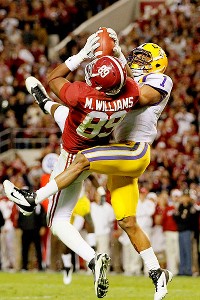
LSU intersepts Alabama's
ball on the 1 yard line.
With my new-found perspective, I'm beginning to enjoy watching football, especially with friends, especially the "great plays" like this one at last weekend's LSU/Alabama game.  Whew, that was something!  I'm not to the point of insanity.  I don't stoop to rudeness (though I might choose not to attend a party at a home without a large HD TV).  I don't care that much who wins (except for LSU), so long as the uniforms are attractive, the cameras catch great video and show lots of instant replays.  I won't be bringing my wireless to an agility trial and listen to a game in between all my runs, nor cruize the arena looking for anybody who knows the current score, like some agility competitors do.  But I've begun to appreciate a good game once in awhile, and especially a spectacular play, even if the people around me are gasping and screeching, cussing the coaches, referree's or players, and in some cases, all blotch faced and crying.

I've also come to realize that football fanatacism is a prevelant disease -- so I've more or less forgiven my Dad for his addiction.  Why, Naylors Hardware practically threw me out last Saturday at 4 p.m. as I was choosing my lettuce plants.  They were closing 2 hours early for the game.

Yes, I've come a long way. And that's another Upwards and Onward for me.

GEAUX TIGERS!


Wednesday, October 19, 2011

Cross Country Races - Part II

A few weekends back I attended my first cross country race, and the very next weekend, I attended my second one, where my grandson was running again -- their last Baton Rouge race.  I brought my sister-in-law Audrey, and Lucky Lucy this time, and met up again with Nathan and Allison.  John, of course, was at work. Knowing more what to anticipate, I captured new and different aspects of the races on video, and succeeded in tracking Jonathan's run much better.  For example, I caught the first 50 or so kids crossing the finish line, including Jonathan coming in at 30 (out of 300), several of his team-mates likewise finishing in the top 30, then the runners being funneled into a cool-down chute and into a tent where they turned in their numbers.  Their tags were stacked in order, and that's how they knew each kid's placement!  No electronic eyes here!  Here's video snippets highlighting all that:


The kids ran a bit slower this weekend and were more exhausted at the end.  Nathan surmised it was because the air quality was worse than last weekend.  It was also not quite as cool.  But the turnout seemed even larger, and all had a "camptown races, doo dah" feel.

L to R:  Michele, Audrey, Nathan, Philippe (Jonathan's
school friend), Jonathan, Allison
We enjoyed hanging out as a family for a change, each of us too busy doing our own things most of the time. Nathan discussed his early running training (which I don't even remember being as how it happened mostly at school and I don't have any pictures) -- how the movement of the legs is dependant upon the way the arms swing!   I found that interesting!  I also enjoyed watching the boys warming up with their coaches, though I didn't get a video of that.  I meant to.

Nathan demoing "deep breathing"
L to R:  Michele, Nathan, Phillippe, Jonathan, Allison
Nathan also gave a demo on deep breathing, which Jonathan and his friend Phillippe tried.  It was entertaining, and Audrey caught this photo of my "ripped" grandson.  Where is my baby boy?  I'm glad he's in a good high school where his energies are channeled into constructive activities and self-improvement.

I found out Nathan is running 5 miles around University Lakes a few times a week these days.  Seems our end of the family is getting more into fitness now, lagging far behind my nieces and nephews (David's kids) who have been doing triathalons, karate, soccer, and lifting weights for years.


Lucky attracts admirers of all ages.
Lucky was a kid magnet, of course.  Kids and grownups came by to pet her, and at one point I put her thru some obedience paces -- heeling off leash, figure 8's, sit/stay/come from about 30' away, finish, and line up between my legs.  Nothing spectacular, except curious onlookers remarked that their dogs could never do that.  (Well, if they'd take them to a few obedience classes, they probably could!)  What I found spectacular was that despite crowds of people milling about close by us and even crossing our path, Lucky was totally calm and "all eyes on me".  I was a very proud mama!

Last weekend was the agility seminar. Tonight I teach class. Tomorrow I leave for the
Kiln trial, so today I'm packing, packing, packing.  Weekend after that, Lucky's CGC test.  Doggie stuff is increasingly taking over my life . . . . . . . my yard, my garden and my house might not agree with me, but . . . . . it's a good thing.

Upwards and onward!

Sunday, October 2, 2011

Running Coach

Jonathan at center, neither boy connected to his shadow.
With all the videos I take, I can study how various agility competitors run.  Most of us can't run!  We take small steps, don't lift our knees, don't swing our arms, don't lean forward, and we certainly never get airborn like the young atheletes in this photo.  There are a few exceptions, especially with the young girls, but very few. 

Since most of us have no occasion to run in our daily lives, who can blame us?  And we certainly don't get any coaching in this department in our agility classes.  I never see anybody warm up before their runs, so no wonder we see a lot of knee and back braces at every trial.  So I've been putting out the Universal Call for a running coach, meanwhile doing what I can to coach myself. 

In answer, this past Saturday I had occasion to attend my 14 year old grandson's cross country race in Baton Rouge, and filmed hundreds of teenagers running (next post).  As the still frame photo of Jonathan confirms, these kids definitely do get airborn.  I watched coaches warming up their teams with sprints, insisting upon waist-high knee lifts that result in more of a cycling rather than a scissors action of the legs, cross overs where the rear leg must lift high as it comes around front, and backwards sprints.  All these young atheletes have two feet off the ground at some point during their trajectory, resulting in less friction and them able to cover more ground.

1/2 # sandbags can be removed
to lower weight
I had already put it together that knee lifts are important, and to that end John bought me some Gold's Gym 2.5# adjustable ankle weights (Wal-Mart $6).  I have been walking around the house with 2# strapped to each ankle a few hours a day.  Gracious, 2# weighs a lot!  For the first week or so, they made my thighs and buttocks burn!  Now I hardly notice them.  You can buy a lot more expensive Re-Bok ankle weights off of amazon.com for $19, but these Gold Gym's do fine, adjust from 1/2# to 2.5# each,  and are comfortable enough.

I'm also practicing taking giant steps around the yard as I lift my knees.  It looks dorky but I can feel the stretch to my inner thigh.

Will all this make a difference in my speed around the course?  All I can do is wait and see.
Upwards and onward!