Description


Wednesday, January 30, 2013

The Lead Leg

Studying Linda Mecklenburg's book, DEVELOPING JUMPING SKILLS, I finally begin to understand what is meant by “the lead leg” and its significance in a dog’s agility performance! For years I’ve asked, and for years no one could explain it to me in a way I could grasp. This book, in Appendix 1, explains it perfectly. Thank you, Linda!

The Lead Leg
The lead leg is NOT the leg that's fartherest forward at a given moment. It's the last front leg the dog lands on in a single stride.  Turns out, it’s the leg easiest for the dog to turn into.


Maxie
It’s the leg Maxie is extending forward in this photo, his right leg, which he will pivot on in making his right turn towards me. The lead leg should be the one nearest the inside of the curve – handling inside the curve cues the dog’s turn, but more succinctly, cues the dog’s lead leg. This behavior is a "natural cue", as opposed to a "trained cue".


Lucky Lucy
It’s the left leg in this photo, for you see that while Lucky’s right foreleg is extended, her left foreleg will be the last leg to complete the stride, and left leg will support her body while her rear feet push off. 

Halliliulih! So, the significance of the lead leg is about balance and direction. The dog landing on the wrong lead leg in a turn tends to spin away to regain balance, or turn wide as they add an additional stride or two to change leads.  Changing leads requires a skill just like when a kid gallops along like a horse, then adds in an extra hop to change lead legs.

Giving turn cues before D takes off over a jump helps D change lead legs before the jump and land ready for a tighter turn. 

I'm making further notes as I read through this "required reading" book in conjunction with Daisy Peele's Online "Agility Foundation" class,  which I am auditing this winter.  I will post my book and class notes when I've completed them, or maybe break it down into different topics like this one.

Upwards and onward!

Monday, January 28, 2013

Krew Of Mutts Parade

Maxie, Pepper and I had a blast at the Krew of Mutts Parade yesterday. This event is put on annually by the local Capital Area Animal Welfare Society, which rescues and raises funds for their low cost/free spay/neuter program.  It was this event 2 years ago which originally prompted me to develop a booth presence for my dog club, LCCOC, so we could let the public know about the dog training opportunities we offer. Here's how it looks so far:

Maxie left and Pepper right, in my arms, our booth behind us.


I had spent the last 4 days painting our LCCOC logo on all 4 sides of our canopy, and was very pleased with how it looked.  The cost of silk-screening would have been prohibitive, not to mention I couldn't find a printer who would do it, so I did it myself for about $5 using 3 coats of fabric paint. We were one of the only booths with an overhead logo, plus we had so many volunteers, we had to set up an additional canopy to shade all their dog crates!

I only brought the two paps, leaving Lucky, Willow and FoohFooh at home. We were gone all day, but Nathan came by and let them out mid-day so that worked out well.

My plan was to have all the volunteers and their dogs walk together in the parade, a sea of blue shirts, with someone pulling my wagon full of beads, throws and literature, while the other volunteers passed out stuff, with Maxie and Pepper riding in the caboose and me close behind them.  I only saw one other Papillon all day, so my two drew lots of attention in their crate, walking around on leash, but especially in the wagon.

But first, Pepper had never ridden in the caboose so I had to do a bit of on-the-spot training.  He looked so adorable misbehaving with his front paws hooked over the edge that numerous passers-by wanted to snap pictures of that, but he quickly learned that he only got treats from Mamma when he sat with both front feet tucked in.  I myself had to resist the urge to reward him for cuteness alone, but the next step would be his jumping out.  Here I am testing his resolve while I reach for more treats.  He is getting much better at impulse control.

Unfortunately, it was unclear when the parade started or where, so we ended up with everyone scattered. Not how I pictured it.  I ended up pulling the wagon alone with my dogs unattended in the back, and no hands for throwing beads or time to pass out brochures. Both sat perfectly throughout the parade, though, demonstrating perfect obedience, and many people made me stop so they could take pictures of the darling pair.  Are they not ADORABLE???? I think Paps look better in pairs.

Pepper left, Maxie right, riding in the caboose.
wearing their Mardi Gras collars and posing for photos.
Only problems I had were the kids demanding I "throw them something" and me with no free hands or time due to the young man behind me who had a large mixed breed shephard dog on a 6 foot leash.  The dog had a long "better to eat you with" snout and kept sticking it in my dogs' faces which of course made me (and them) nervous.  No matter how many times I went back and asked him to keep his dog at a 3 foot distance, he just could not reign his dog in.  No control. No spatial awareness.  Probably no training whatsoever.  If his dog pulled, he moved forward.  He assured me his dog didn't bite, was just being friendly but I didn't care. I eventually managed to put some distance between us, but it was like trying to shake a pesky driver on the highway that insists on riding your bumper whether you speed up or slow down.

That said, nothing bad happened.  In fact, I am amazed every year how hundreds of strange dogs can gather at the event, held on loose leashes by untrained owners, and there aren't many, if any, incidents.

We all came home totally pooped, they conked out, and I began running a fever and coughing my head off.  Today I went to the doctor, got a chest X-ray, and was diagnosed with pheumonia!  No wonder I've been dragging.  Got a shot, antibiotics, and an inhaler and if I don't improve within 48 hours they are putting me in the hospital.

It is also my son's 41st birthday.  My how time flies when you're having fun!

Upwards and onward!

Wednesday, January 23, 2013

Kiln Trial–January 10, 11, 12–1st Trial of 2013

Maxie: 6 runs, 3Q’s, two 2nd place, one 3rd place, no QQ’s,  44 MACH points, 5 videos
Lucky Lucy: 6 runs, 3Q’s, 1QQ, MX TITLE, 7 MACH points, 5 videos


Kiln is generally a great place for RV’ers.  But 9 days of rain made for slushy grass, water filled ditches and puddles to slosh through. My freshly washed Papillons were filty at the first pottie break, and my freshly vacuumed interior was tracked with red sandy mud within minutes.  Fortunately I had old sheets to drape over the upholstered furniture and floors, except the dogs thought them great opportunities for digging. Worse, due to hard rain, we had left home at 4:30 p.m. instead of 1 p.m., which put us there to set up at dusk. While trying to maneuver into a high dry parking spot, I backed over a water spigot and broke the pipe.  It began gushing, we got drenched finding the cut-off valve, the ditches flooded even more, and a whole line of RV’s went without water Thursday night thanks to me. They were not very happy, but the repair guys had it fixed by next morning. Since I carry my drinking water, plus half a tank of water for flushing and rinsing out my coffee cup, and towel bathe or take showers in the arena, I don’t really need water, but I found out some others rely totally on their city water connection, even to flush. 

What I DO NEED is golashes!  Everybody had some but me.  My socks and tennies were soaked, so I made sure to dry my feet as soon as I got in.  And I had plenty of shoes and socks for a dry pair every day.

While packing at home between raindrops, I had discovered a new leak over the bed had dampened the quilt, sheets and mattress cover, fortunately in time to put them all in the dryer.  I had to protect the bed in case of further rain with a vinyl tablecloth.  Good thing John promised me a new rubberized roof as my Christmas present (sweet), but I haven’t done that yet.  Now I’m motivated. This makes 2 leaks now, at each dome roof window, caused by me driving under a low hanging tree branch and making huge scratches in the roof.

Due to the anticipated difficulty pottying the dogs in mud and rain, I decided to bring only Maxie, Lucky and Pepper. Willow screeched in torture as the rest of us departed! John reported she laid by the door for 3 days waiting for our return.  But it was a lot easier managing just 3 dogs.  Her travelling days may be numbered.

Ring conditions were horrible.  Even under cover, the ring dirt was saturated, and the more we tromped on it, the more the water rose.  Here’s how it looked by Day 3.  I’m surprised no one slipped, but I know I ran slower each day, and neither Maxie nor Lucky liked having cold wet feet. You can hear squishing on the videos.

Despite all these and other problems, I felt totally calm. I attribute some of this to working on my mental game, as outlined in my previous post.

FRIDAY.  (dogs ran small to tall, only one ring.)
Maxie was my first dog to run, but not til around 9 a.m. after the FAST class.  So I got to stay up til 11 and watch some TV.  My new air antennae was picking up 8 channels and all came in well despite the weather. I popped open a beer, watched a cooking show, and slept like a baby all night. I don't generally drink on trial weekends, but if this works again, I’ll replace my half sleeping pill with beer!

Maxie had a smoking good XS run, very fast, with a few bobbles but no saves required.  Alas, he took a wrong course near the end.  It happened so fast, I didn't see it coming.  Just an imperceptible push, or not enough pull, on my part.  Even with that WC, his time was 8 seconds faster than the 1st place dog.  I could hardly keep up, but I felt great and never got lost or rattled.  It was the most memorable run of the day despite the NQ.  His XJ run was clean and solid, with a 2nd place and no bobbles, and while an analysis of his SCT and personal time showing he ran even faster, it didn’t feel as fast as that first run.

Lucky Lucy got what I thought was her 1st QQ ever, running faster and surer in both XS and XJ, walking the weaves, but at a faster walk.  She didn’t get distracted.  We felt connected.  Her jumps at 24” were pretty, with ample clearance.  (I found out later checking her records, this was actually her second QQ!) To celebrate, I joined the Red Stick gang at the nearby Delsey’s Seafood restaurant, and bought the table some appetizers. I made Q’s out of the onion rings to decorate. And brought some hush puppies home for Lucky.  The food at Delsey's was somewhat pricy but huge portions and delicious.  Lots of items on the menu, and the best onion rings I've ever tasted, served with a dipping sauce made of Ranch dressing, wasabi, and cayenne pepper.  It kicked ass!

Karen, Christina’s mom, was thrilled to video my dogs on Friday if she could also video her daughter. What a sweet deal.  Too bad she’s just there for 1 day. I hate scrambling for people to take my videos.  I want a mom along who wants to record my every run!  But I if I brought my mom to a trial, she would soon be bored to death “watching dog after dog do the exact same thing”.  It takes a practiced eye to see the endless variety we see. No one but us knows the difficulties we face attempting the miracle of a clean run.
 
SATURDAY: (dogs ran Tall to Small, Lucky on the line at 8 a.m.)
Lucky earned her MX title!  That’s 10 Q’s in Masters Standard (what used to be called Excellent B).  She only had .87 seconds to spare in her XS run, but she made it! Her XJ began with a whimper but ended with a blast.  After falling asleep in the weaves and NQ’ing, she noticed the tripple bar jump, which she loves, and decided to run the rest of the way.  The half run that was good, was very, very good. That's a sequence I'll play over and over in my head.

Maxie scratched in Jumpers, missing the weaves, but Q’d in Standard.  His times were good, not counting slow weaves.

SUNDAY: (dogs ran small to tall, Maxie on the line at 8)
Maxie Q’d in Standard, NQ’d in Jumpers, again popping out of the weaves, otherwise clean. His times were slower, I suspect due to muddier conditions. I know I was walking fast more than running.

Lucky NQ’d both runs, seemingly tired and not focused.  Her first run XS she stopped on top of the A-frame, plcking up Ken's scent in the stands, went down and headed for the sidelines trying to get to him.  Lucky has a serious thing for Ken.  We always have to arrange for Ken to disappear during Lucky's runs, but we both thought up in the stands was far enough away.  NOT. This is developing into such a problem, we may have to stop training together on weekends.  Lucky literally quivers and whines looking in the direction of his RV whenever I let the dogs out.

Didn't get video of either of their last runs.  Couldn't find anyone willing to take them.  I have to quit letting that bother me, but I feel I'm missing valuable information I can use to improve.

There's going to be a fun run in 2 weeks at the same arena.  I'm going.  I can't wait to show some of these agility folks how fast and well Lucky runs when I'm carrying her toy, and I pray someone will take her video then.

I'm having trouble with my AVS Video Editing Software.  I discovered that one of my USB ports gives an unreliable connection, resulting in problems with voiceovers, and it sometimes takes forever for these huge HD videos to load into the program.  After futzing with it for several days and trying Windows Movie Maker again, I got AVS to produce something.  It's still better than WMM.

Maxie's Composite Video, with commentary.  I learned that as Maxie improves, I no longer need to push or pull him very hard to get him to veer. I have to become more subtle in my corrections.  Without watching the videos, I probably would not have picked up on that.  Also need to time my front crosses better.
Lucky's Composite Video, with commentary. I managed to capture a segment in slo mo showing Lucky's beautiful 12' jumping stride, which no one seems to notice but me.  I may have a long ways to go with her enthusiasm for trialing, but I know I've got great jumping skills to work with.

GOALS MET/GOALS SET:
  • My goal of another QQ for Maxie was not met, but we racked up two more Q's in Standard and 1 in Jumpers, leaving only 1 more to go in each class for his Master Bronze Agility Titles - MXB, MJB.  (25 Q's in a class)
  • Lucky's 2nd QQ was a great achievement, plus her MX title. I don't know how long it will take us to get MXJ with 8 Q's to go, but I WILL GET HER THERE.
  • Work on my mental game.
Otherwise the weekend was full of too many oddities to mention, including a see saw whose end got stuck in the mud leading to many fly-offs, how few dogs qualified in class after class, and some turse comments.  The courses were not that difficult, but some of those border collies were running wilder than usual.  Was it the weather?  The barometric pressure?  The wet ground? Handlers unsure of their footing?

There was one magical moment worth sharing.  My friend Sue Cohen handed me a thumb drive with info for a story we're working on, said she needed it back tomorrow.  I promised to download it that very evening, and stuck it in the bottom of my wagon on my way into the ring.  But when I got the wagon back to the RV it had vanished.  I searched high and low to no avail, then retraced my path to the arena, searching the ground.  About tearing my hair out, I told another RV'er about the jinx, and she suggested I look up St. Anthony prayer (patron saint of lost items) on my iPhone, say the prayer, and see what happens.  Said her mother swears by it.  So I went back to my RV, lit a candle, and did it.  Here was my prayer:

     St. Anthony, St Anthony, please come around.
     a thumb drive is lost and can’t be found.
     Dear St. Anthony, I pray
     Bring it back without delay.


Within 5 minutes, a voice said “look in the basket on the table”, where I found a thumb drive I had lost 3-4 months back.  I have NO IDEA how that one got into the RV!  Apparently, one has to be very specific in wording ones prayers to St Anthony.  I repeated the prayer saying “Sue’s thumb drive”, then a little voice told me to look again in the duffle bag I’d already gone through 3 times.  I did, and there it was, sealed in a ziplock bag!!!!!  I will not be forgetting St. Anthony's Prayer!

Is there a patron saint for agility?

Upwards and onward!

Monday, January 7, 2013

Book Review–WITH WINNING IN MIND

For Christmas presents, I bought 3 books on Mental Management: Freedom Flight, With Winning In Mind, and Finding Your Zone. My son who is crazy about golf, my grandson who loves cross country, and I who finally can say I "have a sport" after 60 years without one, will circulate these books among ourselves as a joint present, hopefully finding common ground and helping us all improve our games.

To help me remember the content of each book as I read it, I am blogging my notes, this time on:

With Winning In Mind - The Mental Management System, by Lanny Bassham

Interviewing hundreds of Olympic Gold medalists and World Champion Atheletes, and being one himself, Lanny found commonalities among these elites that led to their successes, primarily that 90% of their game is mental. Lanny used their imput as the basis of his Mental Management System Seminars and coaching techniques. This book is so full of wisdom and tips, one needs a highlighter for sure to catch them all. Phrases such as "we win whenever we advance down the road to achievement". "Winning and being a winner are two different things." "Who you become is equally important to where you finish". "Best to focus on a winning performance, not finishing on top." "Focus on the next step, not on your final score." And all this on one random page!

Most winners don't even know they have won, only that they did each step in sequence to the top level of their capability. Other factors besides your performance can come into play-- weather, sun, course conditions, luck of the draw, placement.

Your self-image as a winner isn't tarnished if you know you did your best, and will grow despite not winning top placement, unless you focus only on a winning score.

Imprinting:
Thinking "It is like me to win" while training, adds to the likelihood that winning will fall into your comfort zone.


"Great performances require less effort than poor ones!"
 
Balance Of Power:
Maintaining a balance between Conscious Mind, Subconscious Mind, and Self-Image is the goal of Mental Management. When the Conscious, Subconscious and Self-Image are working together, good performance is easy.The goal is to experience this state on demand, under pressure.

  • Conscious Mind - we become what we picture. The conscious mind can only picture one thing at a time. If you are picturing a negative, there is no room for a positive. You must train yourself to let go of negative thoughts, and concentrate on positive thoughts only. This requires will power and can only be done for short periods of time - in sports, think only of the next obstacle, the next shot, never about the final score.
  • Subconscious Mind - routines practiced so often they are done by rote, without thinking. The subconscious mind can do many things at once. Skills that become subconsious free us to train our conscious minds on more and more advanced skills. This is how excellence is achieved.
  • Self Image - Performance and Self-image are always equal. To change your performance, change your self-image.
The Triad State:
When your 3 sources of input are balanced. The trick is to grow all 3 while keeping them in balance. If your self-image exceeds your skills, for example, or your self-image is lower than your skills, you can't win.


Affirmations:
  • "I take control of what I picture, choosing to think about what I want to create in my life."
  • "What I say is not important. What I cause myself and others to picture is crucial. I am a positive communicator."
  • "Let it flow." You perform best when you allow your well-trained Subconscious to do the work. When Conscious Mind overrides the Subconscious in crucial situations, performance deteriorates.
  • "I trust my Subconscious to guide my performance in competition."
  • "Picture only what you want to see happen. Your Subconscious will obey."
  • "I allow my self-image to expect more."
  • Be careful who you listen to. When you listen to the problems of others, they will become your problems.
  • Be careful not to complain. Do not reinforce errors in performance, or bad days at the office, by discussing them. Discuss what went right, and more things will tend to go right. What you think about, talk about, write about, manifests in your life.
"I choose to think about, talk about, write about
that which I wish to have happen in my life."  
 
Rehearsal:
When you vividly rehearse an action in your mind often enough, neural pathways are created in the Subconscious that allow for more fluid performances. Also called visualization, mental imagery, positive imagery. Very cool, you can do this any time, anywhere, it doesn't cost a thing and while it doesn't replace physical practice, is a great supplement with similar mental benefits! There is no negative reinforcement. Done correctly it is powerfully effective. You can rehearse beyond your current skill level to what you want to achieve, saying, "I do this all the time. It's easy for me."
 
The self-image cannot tell the difference between what actually happens and what is vividly imagined.  
 
Mental Attitude Rehearsal:
Learn to control how you feel. How confident or nervous you feel can affect your performance regardless of your skill level. Practice “settling down” in a competitive environment or in situations that make you nervous.  Identify what calmness feels like to you, learn to summon that feeling at will.  You can even make yourself have a good night’s sleep by rehearsing things that calm you down.
3 Phases to Mental Management:
  1. Anticipation Phase – preparation.  Do you have all the equipment you need? Is it in good shape? Is your pre-competition routine set and effective.  Are you ready for all contingencies?
  2. Action Phase – the time you are actually performing, varies with every sport (golf as long as it takes to swing a club, agility about 1 minute, running can be several minutes or hours)
  3. Reinforcement Phase – praise what you did right, and recognize others for what they did right.  Stay away from negatives. Getting angry at yourself is totally unproductive.


Running A Mental Program:
a simple series of thoughts that, whenever pictured, will trigger the subconscious to perform the appropriate action.  The Conscious Mind, thus busy, cannot think of anything else.  For consistent effect, the series should not vary.


Most mental inconsistency occurs when thinking about what the environment is giving rather than running your pre-programmed mental program.
Criteria for a Mental Program: to act like a switch
  1. must start out occupying the Conscious Mind, but in a simple way.
  2. must transfer power to the Subconscious Mind as the activity begins and last thru to the end
  3. must be duplicable, no variations, to ensure mental consistency

Steps of a Mental Program:

  1. Point of Initiation – a physical cue that starts the program (enter the ring, take a deep breath, stomp or step forward with your left foot, clap your hands, etc.)
  2. Point of Alignment – in agility, could be positioning your dog, or taking a lead out
  3. Point of Direction -  knowing what you want to have happen first.
  4. Point of Focus – in golf, maybe a phrase such as “See the line, feel the stroke”, in agility, maybe your release word or “I’m one with my dog”, but some last thought before you take action. Could be a song lyric or tempo, this will be different for everybody, but some one thing, always the same, that triggers the subconscious to begin its routine.
Handling Pressure:
  • Pressure is your friend. Don’t avoid it.  Use it. Anxiety/fear is overcome with experience. Tension is required for good performance.  It is normal to feel pressure in competition. Focus on what you want to see happen, not on what is stressing you.
  • Have a planned, practiced recovery strategy for whenever you suffer a disappointment, missed weave, poor shot, etc, Something you can control, like taking a deep breath, relaxing a muscle group, visualize something.
  • YAWNING, even a fake yawn, dissipates tension. Many athletes use this technique.
#1 Mental Problem – Over-trying


Train well, then trust in your subconscious to do the work.  Champions work hard in training and work easy in competition, focusing on process, not outcome, and having fun.

Guidelines to Building Subconscious Skills -
  1. Focus on what you are doing right.
  2. Train 4 or 5 days a week while developing a skill, less thereafter.
  3. *Wherever you are, be all there.
  4. While training, imagine you are competing. Before competing, mentally rehearse a successful performance.
  5. If you are having a particularly good training session, keep it going.  If you are having a bad day, stop training.  Rehearse the good feeling times. Don’t practice losing!
  6. Train with people who are better than you.
  7. Plan your year.  How much training time between each competition?  What will your training schedule be? Training objectives. Make changes in your training techniques long before a competition and practice them frequently until they become sub-conscious routines. How much money will you need for the year?  New equipment, supplies, etc. Get all that organized. Plan some down time after each competition, very important.
“Winning is not an accident. 
You must plan your work, and work your plan.”

Performance Journal:

Keeping a daily Performance Journal is a must or you won’t actually know if you are progressing. Journal records when you practice, for how long, field conditions, what you practiced, what worked. Goals should be written down and worked towards.

“You can’t manage what you don’t measure.”
“Writing has a greater impact on the self-image
than talking.”

Never record your mistakes, only what went right.  Self image is created by the record you keep of progress.

Imprinting:


Self image is changed by “imprinting”. Visualization is “seeing”, but imprinting is “feeling”.  How does a successful performance “feel”.  An imagined clean run can feel about as good as a real run, and can be repeated over and over from just about anywhere.  Rehearse the feeling of success, especially just before and just after the real event.  Even if the event was not a success, you will have 2 successful imprints to override it. The subconscious can’t tell the difference between real and imagined events, nor can it tell time.  Each time you recall an experience the subconscious experiences it as a new event.  You are in control of the imprinting process.

 
If you catch yourself worrying, just rehearse performing well.
Steps to changing the Self Image:
  1. Be willing to change
  2. Identify a habit or attitude you need to change
  3. Identify a new self image to replace it
  4. Exchange them.  Whenever the old thought pops up, notice it and run the new sequence.
Directive Affirmations:
  1. Write a goal
  2. Set a time limit
  3. What’s the pay-off?
  4. Outline a plan to achieve the goal (what you will do)
  5. Restate the goal
Write 5 copies of a Directive Affirmation, on 3x5 cards, and tuck them in key places.  Read them every time to see them.  In 21 days, either your self-image will change, or you will have quit reading them. Once achieved, tweek the DA, or run a new one.

Decisiveness: 
a very powerful asset and self image maker.  To avoid indecisiveness, here are some tips.
  1. Novice competitors should treat early competitions ONLY as practice, learning experiences.
  2. Discipline yourself to only think about what you need to do, not what you already did. Don’t dwell on errors.
  3. Don’t expect perfection, only improvement.
“Perfection is the purest form of procrastination.”

Promotion:


Promote yourself with “I’m getting better at this”, rather than “I’m doing poorly.” Be a promoter of yourself, your organization, your coaches, and others. Be grateful for all the help you are given. No champion does it alone.


Promote others as follows:

  1. Make eye contact when you speak to people
  2. Remember their name
  3. Praise in public, correct in private.
  4. Praise twice as much as you correct
  5. Never steal a dream or limit a goal
  6. Never give up on anyone. People choose their own times to become champions.
Remember, if every attempt was successful and nothing ever went wrong, you would soon be become bored.  Winning is special because it is so difficult to do. We appreciate things in proportion to the price we pay for them.
_________________________________
These notes just scratch the surface of what's in the book.  It's a wonderful read, full of hope, examples and wisdom.

Upwards and onward!

Saturday, January 5, 2013

Bad Dog Agility Podcasts - My Notes

The Bad Dog Agility blog includes links to 29 Podcasts as of now-- interviews with various agility experts on the latest agility techniques.  I can listen to them on my iPhone thru iTunes while lounging in the bathtub, driving, or at a trial with no internet connection!  They are so packed with useful information, unique perspectives, and training tips, I listen to them again at my computer, taking notes to stay focused.  The notes don't even begin to cover the content but at least provide me with reminders of where to find the information.  I encourage every dog agility trainer/competitor to visit the blog and listen to the podcasts.

Upwards and onward!

In these notes, D stands for Dog, H stands for Handler.

Podcast Summaries (in the order I listened to them):

#24 Interview with Sylvia Trkman - Running Contacts - Sylvia is a World Champion Competitor with 3 dogs, from Slovenia.  Trains and competes throughout Europe, and teaches online classes, sells DVD's, etc. Her concept for teaching running contacts is first to teach D to run across the dogwalk as fast as possible without regard for contact behavior.  First teach speed.  Then begin to reward with clicker and higher value treats when feet hit the down contact, preferably rear feet, then exclusively rear feet.  10 reps a day 5 days a week for newer dogs, 20 reps for advanced dogs.  No stride regulators. D should be in a high state of arousal for dog walk practice.  Show them their toy.  Even if they miss the contact, always reward for speed.  Throw it ahead, eventually past a jump after leaving the dog walk, timed so they don't get in the habit of head checking H.  Eventually they will figure out that hitting the down contact earns them a bigger prize.  When that light bulb goes off, they rarely miss again and H doesn't have to babysit the contact. Only if your dog is way faster than you should you train a stopped contact.  If you do teach a stopped contact, except to see your dog slow down on the approach to the contact and a significant loss of speed time. Once you teach dog walk contact behavior, you get the A-frame and see-saw for free!  Lots of good info on how they train/compete in Europe.

#7 Mental Management - Daisy Peel - Think about process and performance, not about winning. This alleviates a lot of pressure, not just in agility but in all of life. The mental game is a skill that needs development and takes conscious effort. It needs to be available on demand, and can be fatiguing. Biggest mistake agility competitors make is "overtrying"-- trying to make something happen rather than letting it happen. Recognize when the adrenalin is flowing and use your arousal state to your advantage. Start down the Mental Management road by asking these questions: what would you like to have accomplished with a particular dog by the time they retire? How do you want other competitors to think of you and your team? What qualities will you need to achieve this goal? What's causing your errors? You can't control events or the quality of those events but you can control the quality of your participation (attitude, behavior, focus). It's all in how you look at it. Video yourself: Splice all of the best parts of your best runs together and watch them. 
Inspirations:
Buck (horse whisperer) movie.
With Winning In Mind, Lanny Bassham's mental management system.  Teaches the mechanics of having a plan how to switch off your conscious brain just before you enter the ring, get in the zone. This is a conditioned response you need to work on.
Clear Mind, a book on goal setting,
Freedom Flight - The Origins Of Mental Power, a story.
Mantra: I can do more than I think I can.

#15 Kathy Sdao - Part I, Animal trainer, marine mammals, then dogs. Clicker expert. Her book: Plenty in Life is Free, opposes the notion that dogs should never get a reward unless they do a performance. Don't take the joy out of living with your dog.
Science of operant conditioning. Clicker Expo teacher.
Classical conditioning works on a dogs reflexive emotional behaviors--barking, charging, cowering, etc.
Operant conditioning works on changing behavior--down contacts, weave entries. Cuing clearly, getting verbal and body cues to match up. Dogs read body cues far better than verbal cues. Humans, though, are largely verbal. It's a mismatch, humans have to take the responsibility to be more clear, more conscious of our bodies -- eye movement, foot placement, etc. -- fewer and clearer verbal cues. High drive dogs are going to make a choice, even a wrong choice. Low drive dogs will wait until they are sure, and may slow down, stop, become anxious.

#16 Kathy Sdao - Part II - Speed
Clicks stop work. Can't use a clicker to reward speed. Your reinforcement has to be a well timed cue. Hard to judge speed, so you have to visualize a bell curve and reinforce for "better than average speed" within an acceptable range, not "fastest speed". Don't poison your cues with positive punishment (lack of positive reinforcement). Dog should always get something. Differential rewards vs. no reward will get you much better performances, keep you engaged with D. Agility Right From The Start. Most dogs will learn that improved performance gets bigger rewards, but trying also gets a reward. Some dogs don't lose interest for non rewards, others shut down. Know your dog. Your power lies in your ability to give plenty of positive reinforcement. You should reward dogs for offering behaviors you don't even ask for. If D is lying quietly while you're on the phone, reward out of the blue. Look for opportunities to reward. You don't reward only for the dog obeying your cue. Don't use the filter of "did you earn it" for dispensing every reward.

#22 Secrets To Super Agility Performance - Part I Sarah & Estaban
Criteria of Reinforcement - Define your criteria - what does D need to do to earn a reward? H must be very clear on this.
Timing of reinforcement:  . E-book: Clicker Training - 4 Secrets Of Becoming A Supertrainer. Use a clicker or otherwise mark the correct behavior BEFORE giving a treat, or dog may come to feel he is being rewarded for coming back to you rather than performing the sequence. Release to the next obstacle is a reward for performing the previous obstacle. Behavior chain training encourages speed. Rewarding for speed means not stopping mid-sequence if D makes a mistake. Differential rewards - reserve higher value rewards for best performances. If D prefers toy to food, reward with food for attempts but toy for great performance. break down behaviors to a single thing. If teaching a 270, lower or remove the bar. Remove the need for D not to knock the bar. Teach one thing at a time, so you can reward one thing done well.

#25 Secrets To Super Agility Performance - Part II Sarah & Estaban
Rate of reinforcement: number of reinforcers D can earn in a certain amount of time.  Keep this high, especially at the beginning. Keeps D trying even when they make mistakes. Try hard to improve this, training not too far above D's current level so they can get it right and get rewarded more often.  Manipulate the environment, not your handling, to make D more successful but still challenged.  Backchain as necessary to keep an 80% success rate.  Hard to chew treats, tugging, takes more time, you can't get in as many reinforcers. Transitions (getting back to the start line) takes lots of time, too.  Tug on the way back.  Length of behavior affects rate of reinforcement, too.
Quality of reinforcement: What does your D love the most?  What puts them in the highest state of drive? Figure this out. Try lots of things. Develop a range, reserve the highest level treats for spectacular performances or long sequences that lower the rate of reinforcement, and deliver lower level treats for attempts, high frequency of delivery, or correct but slow performance.  Praise is also a reinforcer.
Interesting Article: What is "usable food drive", dogs who love treats even when they aren't hungry.   Do All Dogs Have Food Drive?
Placement of Reinforcement: Poor placement can cause head checks, extra strides, slower speed, especially in sequence training. H needs to consider where they want D to go -- toward you, away from you. If D prefers food, can get them a trick to fetch the toy to get the food.  Clicker training helps you deliver the reinforcer at the exact moment the correct behavior takes place without as much need to reinforce on D's line.

#10 - Training with Food, Training With A Clicker, Sarah & Estaban
Trainers forget to reward once their dog is into sequencing. Tugging has taken over as the best reward, but with dogs that don't tug, food is the motivator. Rewarding on D's line is harder with food unless you use big hunks of food that toss far. 1/4 hotdog, 1/3 string cheese, bisquit. Have food ready in hand, don't root for it in your pocket after the sequence is done. Timing of reward is essential to build drive, prevent D from curling into you for their food reward. Treating from your hand builds handler focus, not obstacle focus and encourages head checks. For little dogs who don't eat much or retrieve, can slather a toy with peanut butter, toss toy on line and deliver the food. Or, put target at end of sequence. Downside to this, they get the treat even if they make a mistake. Best to have a helper, or put treats in a container D can't get to treat until H takes off the lid. For big dogs, a big glass jar they can't run off with works.
Luring:  Dog thinks less, drives more.  Targets are lures. Agility Right From The Start.
Clicker Training: Marking a performance in a consistent way. Takes less reps for D to learn to do what you want. Sylvia Trkman clicks everything. Shaping obstacles with clicker gives better results, more confidence, less fear (dogs choose to do the behavior rather than being lured over it). Continue using the clicker with advanced dogs.

#11 - Rear Cross
Not too many rear crosses in international agility. Younger competitors there vs US.  RC important for less atheletic handlers. FC gives you more control over D, if you can get there. Walk courses with both RC's and FC's. Never know when you'll need that RC. Judges are now designing courses where the FC won't work. RC combined with other moves is now sometimes needed to complete a maneuver.
Cons: Not easy to teach D to be comfortable with RC. D has to be in front of you, needs obstacle focus. D looses eye connection with H for a moment. Hard to catch up from being behind D.
Pros: With fast dogs, H is often behind D, the RC is the only way to cross. Sometimes there is no time for a FC. RC gives H more wiggle room.
Read more RC articles at www.baddogagility.com

#14 - What Makes A Good Coach/Instructor (Blog Action Day)
First, what knowledge does an instructor bring? Reinforcement theory? Problem solving? Specific skills training? Mental game? Don't need to be a top-notch handler to be a great coach. Needs a critical eye, be able to watch someone carefully, pinpoint problems. Great handler does not necessarily imply they can teach what they do. You get different things from different instructors, use multiple coaches. Good communications/student interaction is a must -- attitude, tone, level of criticism, articulation of concepts, two-way communications. Ability to inspire, keep students going through the rough patches.

#13 - Agility Calendar Girls, by Katie Long and Cat Clark
Fund raiser for cancer, Katie and Cat lined up volunteer agility competitor models to pose half-nude on agility equipment, one calendar with sexy Great Britian gals, another with US girls, 2013 calendar can be ordered online at http://baddogagility.com/episode-13-the-agility-calendar-girls, 2014 calendar will be men.

#17 - FCI World Agility Championship 2012 Preview
www.agility2012.cz
38 countries sending competitors.
Lisa Frick/Hoss (Watch her YouTube videos)
Linda Martin Hill
Croatian Shephard (Mulch Kennel) - watch this breed
Astonia has a Papillon
Laura Chudley/Rodney, UK Calendar Girl, great team
Nicola/Twister Lots of backwards and bent over running
www.agilityvision.com $19.99 to watch the whole thing, one year access.

#18 - FCI World Agility Championship Wrapup - Day 1
In Europe, Agility=Standard, Jumping=Jumpers.
USA Team Large Dog took 1st place, followed by Slovenia, Switzerland, Belgium, Germany, France, Astonia, Italy, Hungary, Canada finishing 10th. Only 1.99 seconds difference between 1st and 4th place. Lower on the scale, 20 or more other countries, but some of their dogs ran very fast, and tomorrow these teams could move back up into 1st, especially if the top teams make mistakes. USA Team members: Daisy Peel and Solar, Solvena Burara? and Tecam, Tori Self and Rip, Tori and Icon. More familiar names: Susan Garrett, Greg Derrett, Sylvia Trkman & Boo (Slovenia). The best runs were all under 30 seconds. Individual dogs who came in under 29 sec: 1st place Austria/Hoss 28.51 sec; 2nd place Croatia/Tip 28.83 sec., 3rd America/Tecam 28.86; 4th Finland/Gia 28.91, 5th USA Tori/Revolution 28.96, 6th Zen 28.97

#19 - FCI World Agility Championship Wrapup - Day 2
Small Dog Teams Jumping. 1st place Hungarians 2nd Japan, 3rd US, all dogs had time faults. Won't run Standard/Agility until tomorrow.
Large Dog Team Standard Results: Gold-Switzerland, Silver-Germany; Bronze -Italy, only these 3 had 3 out of 4 clean runs, US 4th Daisy Peel's Solar fell off the top of the dogwalk. Another American dog jumped over the weaves, maybe thinking it was a broad jump pole. Lots of dogs missed the weave entry. Whenever anyone disqualifies, they play music and start clapping.
Martina Clemisova/KiKi, a Mudi, won gold in Medium Agility, Czech Republic

#20 - FCI World Agility Championship Wrapup - Day 3
Small Dog Team Standard - Gold, Silver (Czech Republic), Bronze
Dog Sports Video provides video overlays of 1st and 2nd place winners in each category, showing the small differences in handling that make the winners win. Also the similarities in handling.
Individual Small Dogs Jumpers - 60 dogs ran clean. 28.97 for 1st place, Tobial Wust and Peanut, 2nd Techna, runs on video, w overlays here.
Only US dog to Q ran 32.9.
Individual Medium Dogs - Natasha Wise/Dizzy 1st 28.98, DeeDee 2nd 29.09.  Video overlay here.
Individual Large Dogs - high Q's, very technical course, Susan Garrett/Feature off course, sometimes a wide turn made all the difference in placement. Daisy/Solar nice run 20th place, could still come up from behind. Lisa Frick and Hoss, amazing run, 1st place, ran backwards thru 3 obstacles, unusual BC's, unique handling style. Video here.

#21 - FCI World Agility Championship Wrapup - Day 4
Final day, both jumping and agility, all dogs. 
Agility: Difficult dog walk entry, tunnel wrapped around both sides, NQ'd a lot of dogs.  Exit was straight to next obstacle, an advantage for those with running contacts.  They run the lowest ranked dogs first.
Small, 1st and 2nd went to the same two small dogs.  Techna and Peanut, Peanut and Techna, with almost identical times.
Medium, Sylvia and Le, beautiful run 1st place agility round, raw speed, tight turns, running contacts. Video. Sylvia also took 8th place combined, with La.
Nathasha Wize and Dizzy (GB), got 3rd place, and combined with 1st in jumpers, gold overall. 3rd world championship with Gold in 4 years.
Large: US all ran 4 for 4 all weekend.
Sylvia and Bu, 9th place going in, ended up neck and neck with Daisy Peel and Solar for Gold and Silver (5th), but got bumped by Cayenne, Silver; and Heat, bronze run, Lisa Frick Hoss and last dog to run, bumps others out to 1st place in agility and 1st in jumpers, gets Gold Combined. 3rd world championship run, video here.

#1 - Using A Crate In Training
Putting dog in a crate, rather than on a leash in class, releases D to pay attention to other things than you, goof off, feel safe.  Gives H time to walk course with full focus, without checking where D is. Crate gives D permission to do other things.  D on leash, he should be paying attention to you.  Putting D in a down or stay becomes an Obedience exercise, which drains some of their energy.  Crated D is safe from interference from other D's.  Also, putting D in crate after their turn imitates the trial environment.
Discussion of conditions at AKC World Agility Team Tryouts, and advantages of attending - see latest handling techniques, only one ring so you get to see it all, lots of cheering. Available on the web at Video On Demand, also available on www.agilityvision.com
Also some runs probably on YouTube.

#2 - AKC Worlds Agility Team Tryouts 2012, Sarah & Estaban with Brittany Schaezler
Discussion of each dog that made the team and why, plus performances by many teams who didn't, and teams to look for in the future. This competition is viewable by purchase from www.agilityvision.com  Illustrates that some people are following agility teams as avidly as other people follow football players' careers.  Interesting! AKC's coverage of the competition was amazing, fast, and thorough, including course maps, running order, videos, and scores.

#29 - 2013 AKC National Agility Championship Preview
Crunching the numbers and stats on who will be competing in Tulsa in March 2013. Very detailed.  Powerscore was used to analyze the stats. Each dog's average YPS in both Jumpers and Standard over the past year is displayed in an Excel Spreadsheet for each height class, and ranked accordingly. Dogs' full name, and call name, are given, nice for doing your own research of YouTube videos of that dog's runs and following their career on dogscores.com.  Great to see someone following agility dogs and handlers the way millions follow football/basketball/baseball/tennis players' careers.

#30 - Analyzing Your Mistakes In Dog Agility
3 basic types of mistakes:  execution, dog's understanding, handler's understanding. After running together several years, execution becomes the main type of mistake . . . forgetting the course, poorly timed cross, tripping, failing to create a line, etc.  Dogs also make errors in execution, yes they do.  Don't avoid a maneuver because you think you're bad at it. Crosses, threadles, serpentines, ketchkers, become easier as you train them.  "Practice like you compete, compete like you pactice."  Whatever criteria you use at home, use at the trial.  Proof your dog for the trial atmosphere.  D needs to understand your cues at speed, at a distance, with multiple distractions, with various spacing between obstacles.  Every cue needs to be distinctive, different from any other cue, so D can understand it at speed, at a distance.  Named handling systems can divide people up, but actually everybody develops their own system.  Can be a different system for each dog you run.  Whatever, H's set of cues should be consistent for each D. Even the most well-known systems evolve as their developers gain in their own understanding of how to execute, and students apply pressure.  Be adaptable, not rigid. Be open to commentary from fellow competitors you trust, who may see things you can't see.  When you change your system you have to go back and retrain your dog in that area.
http://baddogagility.com/analyzing-your-mistakes-in-dog-agility/

#27 - "Off Breed" Dogs in Agility
Defines "off breed" dogs as anything other than Border Collies, Shelties, and Papillons, based on the preponderance of these breeds competing and winning at the highest levels worldwide. Useful distinction because it helps serious handlers choose an agility dog that is easy to train in agility and can win. AKC Invitational described, where only 5 dogs of each breed (and mixed breed) are invited, perfect for "off breed" dogs - grouped by both breed and group. There are also breed-only competitions, where off breed dogs don't have to compete with top agility breeds, and these dogs can earn recognition. Some breeds are harder to train, for example lots of Goldens are sensitive to sound and touch, resulting in not liking the see-saw, others mature late, some have little prey drive. Physical traits come into play based on stride length, stamina, heat sensitivity, focus.  Still, many run an off-breed dog for love of the breed.  Important to find an instructor with experience in your breed, or at least with many different breeds.  As an agility handler's agility goals rise, maybe aspiring to compete at worlds, they may choose a dog with a greater chance to win rather than their favorite breed.  Everyone's goals are valid.  Learn your dog's tendencies regardless of breed and train to that.

#3
Clicks stop work.

#4
Clicks stop work.

#5
Clicks stop work.

#6
Clicks stop work.

#8
Clicks stop work.

#9
Clicks stop work.

#12
Clicks stop work.

#26
Clicks stop work.

#28
Clicks stop work.

Sunday, December 30, 2012

Book Review - FREEDOM FLIGHT

For Christmas presents, I bought 3 books on Mental Management:  Freedom Flight, With Winning In Mind, and Finding Your Zone.  My son who is crazy about golf, my grandson who does cross country, and I who finally can say I "have a sport" after 60 years without one, will circulate these books among ourselves as a joint present, hopefully finding common ground by helping us all improve our games.

To help me remember the content of each one as I read it, I will blog my notes, starting with the one I read over the holidays:

Freedom Flight - The Origins Of Mental Power, by Lanny Bassham
This is a short book but carries a big punch.  Fictitious, it's also a composite of the wisdom of 3 real life people who influenced a real life Olympic champion (the author) to win Gold after many years of struggle to get there.

Synopsis: 
A soldier is captured and held as a Vietnam war prisoner for 6 years, plus spends several weeks in solitary in a 4'x4' bamboo box, without much food or water.  He pares life down to "what's important and what's not", and what he does to keep from going crazy is  to not worry about things he can't control, control what he can, and play golf in his head.  When he gets released back to the US and steps onto the golf course, he's rehearsed so many thousands of great shots in his mind, they come to pass!  He relates this story to the future Olympian on a plane flight, giving him the pearls of wisdom he needs to free himself of his self-limiting fears and attain his goal of Gold.

Summary: 

Here's the list of positive mental imaging tricks imparted:
  1. The Lesson Of The Box: Until you get out of the "prison" of your self-limiting concepts, you aren't free to reach your goals and dreams. How do you do that?
    Establish a Plan
    Learn to separate what is important from what is not important in reaching your goals, and let the unimportant things go.
    What you think about AFTER something happens to you shapes the fabric of your future. Don't dwell on unimportant things.
  2. It is unimportant what happens to you in life. What is important is what you do about it.  This is how you live a "purposeful" life, rather than be a "victim" of life.
  3. Adversity is an effective teacher. Tragedy causes us to separate what is important from what is not.  Shows us we can't control all events, but we can control how we react to them.
  4. Everything we experience in life is a preparation for our future.
  5.  "To he who has been given much, much shall be required." If you focus less on your personal achievement and more on the good you could do by achieving it, you are more likely to win.  Changing your Purpose this way changes your focus, relaxes you, makes for easier performances.
  6. The way you see things is reality.  Your actual environment is not reality. Perception is everything.
  7. Focus on solutions to problems, not on the problems themselves.  Change your thought pictures.  Can you control your thoughts?  Do you try?  If your mind starts down a negative path, can you pull it away?  When you are in a situation you can't control, try to replace worrying with thinking happy thoughts that bring you joy.
  8. Presets - We have many presets in our heads, like car radios where you press the button and it takes you to a particular station. Learn to identify your presets, and reset them to advantage.  For example, you can learn to step into the ring and all else fades but you and your dog running together beautifully. The mind cannot tell the difference between what you vividly imagine and what you actually do.  Replace "I can't run well" with "I run like a pro" and envision it, you can achieve it.
  9. Every life has a purpose.  Everything happens for a reason.  Learning to see the benefits of everything that happens to you is important.
  10. Every purposeful life has a God ordained plan. Once your goals are in sync with this plan, good things will begin to happen easily.
  11. Even if there are no doors currently open to you, continue to think about your plan.  Doors eventually open to those who are determined.
  12. The world tends to only measure accomplishment.  But you can also measure the state of your "becoming".
  13. The conscious mind can only focus on one thing at a time.  Focus on what you want to happen and not what you fear might happen.
  14. God endows us with weapons to fight through adversity.
Conclusion:

For years after meeting the Vietnam Prisoner on this flight, the author could not afford to train for his sport.  He set up a room in his home as a shooting range, and every day practiced aiming and shooting perfect shots.  Years later the chance came up to join a team and qualify for the Olympics, he did, and won Gold.

Upwards and onward!


Wednesday, December 26, 2012

Daisy Peel Podcasts - My Notes

I've discovered online agility podcasts recently and begun listening to them.  I listen while sipping my morning coffee after I've fed and pottied the dogs, before I feel like doing much else.  Taking notes helps me pay attention.  Last week I discovered Daisy Peel's Podcast page on her website, and here are my notes. Some discuss concepts, others describe the content of her online training classes (#12 of which I'm really interested in taking):

Podcast #1 - What Is Consistency?
How to achieve consistent performances you are happy with?  First, define what you have right now (behavior, performance, feelings).  Define what you want.  The difference is where you train. Come up with a training plan to shift your pattern.  This may take you out of your comfort zone.  Allow for mistakes to happen as you experiment. You'll get there eventually.

Podcast #2 - Being In "The Moment"
Success is achieved by coming at it sideways.  You'll learn to recognize the feeling and be able to stay in "the moment" longer.  If you try to hold on to it, define it, celebrate it, it will disappear.  Learn not to analyze it at the time.  Eventually you'll be able to slip into "the moment" at will, and the moments will last longer.

Podcast #3 - Thoughts on Using Verbals On Course
As set out by Linda Mecklenberg, we communicate with our dogs thru 6 things: motion, shoulders, location, eye contact, arms, and verbals, in the order that the dogs best understand.  If motion cues are correct, dogs won't get so many incorrect forward motion cues.  There will be less need for verbal cues.  We are more verbal and upper body oriented, dogs prioritize lower body movements, and verbals least of all. To see if D is reading your body in practice, eliminate verbal turning cues.  Reserve verbal cues fo instances where your motion doesn't support the next obstacle D needs to take.  Use verbal forward cues - jump, weave, okay, table, tunnel, over, around, out - to confirm what the dog should do even while you are moving away.

Podcast #4 - How I Chose A Handling System
Linda M's 6 basic cues represent a scientific approach to handling, a good place to start.  You learn different things from different trainers. But after awhile, you will have to start learning from your dogs on your own and see what works.

Podcast #5 - Bang For Your Buck
How much should a working or auditing spot cost?  Lot of factors to consider:  experience of presenter, teaching style, venue, costs to put on the seminar.  Sometimes you could get more bang with private or online lessons.

Podcast #6 - Our Goals All Serve The Same Purpose
From the Daisy Peel Mental Management Class, Not satisfied with our current situation provides a source of frustration as well as motivation.  We set our sights a little higher, and the end result is self improvement whether our goals are international or local competitions.

Podcast #7 - BDA Mental Management
Bad Dog Agility's interview with Daisy Peel: Landy Bassham (With Winning In Mind) is Daisy's mentor on Mental Management.  Consistent performance under pressure, on demand. Applies to all sports, parenting, etc. Pressure to perform agility well is intense, but improves with less attention on Q'ing or winning, but on process and performance. Self image and fear of poor performance limit us.  You have to practice your mental game skills in daily life, not just when competing. Like a muscle, you have to work on strengthening the skill, which is very fatiguing until you get used to the process.  Worst mistake is "overtrying" -- making things happen rather than letting things happen. Whatever level you train at is the level you should exhibit in competition.  But the adrenalin at competitions can make you achieve things at a higher level than in practice, without trying. Good performances seem easy, slow motion, sub-conscious, mentally effortless. Visualization: Thinking about the trial before you get there: YouTube search will bring up videos of runs in any venue you are about to compete in.  You can see the environment before you get there.  Babe, Buck, Rocky are good movies to watch.
  • Anticipation phase: get your conscious brain to turn off at the gate, stop processing details, a conditioned response, a mantra, tune, or gesture that gets the ball rolling automatically.
  • After-the-event phase: to avoid let-down from winning or not, have a plan.
Podcast #8 - Equipment Safety
Competing all over the world, seeing how other countries design, purchasing and bringing home diverse equipment to practice on in preparation for international competitions. Dog eye injuries suffered by jump cups above the bar, recommends 1 moveable jump cup that is easily adjusted, which will be cheaper in the long run, no bottom bar so uprights can fall independently. No horizontal pickets on wings, looks to some dogs like panel jump. 

Podcast #9 - Watch Your Dog - Part 1
You have to watch your dog to know when to give your cues. This is a mechanical skill.  Doing that well is complex.  Static visual acquity (near and far sightededness) is less dramatic than dynamic visual acuity, improving
  • your visual motot skills -- focusing, tracking (following in smooth path) or psychotic pursuit (flicking eyes from one thing to another), convergence/divergence (judgng distances). 
  • your visual perception skills  (figure/groud)
  • peripheral awareness, making good use of the info that is coming in to you.
  • hand/eye and foot/eye coordination 

Podcast #10 - Watch Your Dog - Part 2
"Watch Your Dog" is an oversimplified request. Requires practice.  Dogs track the direction of your head which leads to many mis-cues, so learn to turn your eyes without moving your head, also enhance your perephrial vision by noticing what you can see to the sides without moving your eyes side to side.  You'd be amazed how much you can see.  Exercises provided.  When walking a course, pay attention to how you will watch your dog.  Where will your eyes be?  How you handle your eyes is important.

Podcast #11 - Interview with Helen Grinnell King
How canine structure relates to performance. What's Your Angle and  Picking Your Performance Puppy, and Based on equestrian knowledge.  www.recipetowin.com What allows dogs to accel/decel, turn, stride, etc.  Pelvic and shoulder angles are important.  Must learn to see these.  Books show you how.  Structure evaluation class. Hands on is best, but learning to read photos works too. Eweneck discussion - not bad on dogs as it is on horses.  Slipped hocks discussion. Online class thru Daisy Peel website - 6 step process how to see angles on dogs, submit and evaluate photos of your dog.

Podcast #12 - Interview with Kristin Rosenbach, ATC, Stott Pilates Certified Instructor
Functional Fitness #1 -  Training basic movements, rather than muscles. Balance exercises, mechanics of accel and decel, coordinated foot movement, posture, visual skills, strength work. 9 week class thru Daisy Peel's Online Courses. Forum, post video, exercise logs.  Balance is the first problem to tackle.  Pullers - Body Weight Back, must work harder.  Pushers - teaching people to lean forward and let gravity help them.  Lateral movement - stepping to the side is not normal, especially at speed, including visual changes. Balance affects confidence.
Functional Fitness #2 - Multi-Dimensional Movement, moving one way while looking another, spatial awareness, strength work.

Podcast #13 - Interview with Bobbie Lyons
Pawsitive Performance helps dogs know where their body is. Works with canine conditioning, structural issues.  Teaches private lessons and online classes, and private practice evaluating dogs muscle structure. Training dogs to go from a stand to a sit to a down without moving their feet at all, helps them use their core. Dogs with this training show improved speed and tighter turns on course.  Warm up and cool down routines are important, especially major joints, spine and tail.  Trotting around (medium speed) before taking the warm up jump very important - warmup should take about 10 minutes. Backing up, turning in a circle all very good, and don't take much room in the house.
pawsitiveperformance@yahoo.com
www.pawsitive-performance.com

As she posts more podcasts, I'll add more notes to this page.

Upwards and onward!

Wednesday, December 19, 2012

RV Improvements

Reviewing my Page Views stats, the most visited pages on this blog have to do with RV Improvements!  Being as it's such a hot topic, I decided to catch the world up on my latest renovations on my Class C 27' Four Winds 5000, circa 1999.  Simple things that solve problems, make better use of limited space, and sometimes save money on far costlier solutions.

Low cargo door
High cargo door
Instant Outdoor Table:  "Mainstay Easy Hang Shower Rod" with non-skid rubber tips, very convenient for holding up the side compartment door, providing an instant table before unpacking any patio equipment.  The fact that the rod is adjustable from 36-60" and locks in any position makes it so the table can be leveled on very uneven terrain, and can prop up both the low or high cargo doors.  It gives me a place to put my coffee cup, cigs and ash tray, snacks, leashes, light tools, etc., while setting up my camp space. Cost: $6.95 (Walmart).  Why those RV engineers don't build in fold down legs for these compartment doors I can't figure. Not pictured, but I got some plastic mats to put on the surface to prevent scratches.

Leveling Boards: Whew! I priced those installable crank up leveling jacks, the yellow plastic locking leveling boards, and figured I could save myself a heap of money just making my own. After a bit of experimentation, I learned I could get all the leveling I will probably ever need with the pictured 3/4" thick 4" wide, 8" long and 16" long wood fencing boards. (I found a few of these boards on a scrap pile somewhere, and cut them the width of my tires.) I carry 2 sets. Cost: $0


I create a ramp behind the tires that need lifting, 2 boards thick, then 4, then 6, then 8 boards thick as needed, and easily drive the RV up onto them.


Both back tires rest on the long boards.


The longer boards provide a final resting place for both back tires to sit on, but the shorter boards are sufficient enough ramp to lift the unit using just the outer tire.


It surprised me how just a few inches thick makes a huge difference in leveling.  See how the unit is completely lopsided driven up onto those 8 boards pictured above?  And walking inside is difficult on this angle.  But if I wasn't on level ground already, you can see that I could make it level using my method.  Oh, and don't forget to chock your other tires so the unit doesn't blow off the boards.


Hanging closet conversion to shelves and bins.  I don't bring hanging clothes on trips, but if I did I have a second closet with a hanger bar.  So in the bigger closet I built 2 shelves to hold 3 16" x 22" Sterlite bins.  One is for my clean clothes, another for dirty clothes, another for a second person's gear, linens and pillows, or whatever.  I've stacked a 4th bin under the 3rd one, in case I need a large container to put wet stuff, wash a dog, store live fish caught in a nearby stream, or other useful purpose.  I built the shelves by lining the side walls with 3/8" plywood cut to fit, stained to match, and screwed in, then laying a 3/8" shelving board across the top, then repeat with another set of uprights and board.  Voila!  A much more useful space. Cost: $25 (Target for bins, Home Depot for wood)


WINDOW TREATMENTS:

Stained Glass Window:  I hate those curtains and flimsy curtain rods around the top bunk.  Romping up there, they are always bending, popping off, and the hardware sticks out and pokes/scratches you.  So I got rid of the long one and coated the interior window with a stained glass sheet (comes in a roll from Home Depot, several designs).  You clean the window immaculately clean, wet the precut sheet with soapy water, and position it on, then work out the bubbles with a credit card, per package instructions.  Once on, it stays there by suction. I've had one up on my art room door for years and it's still there.  But it comes off easy if you ever want it to.  It's pretty, creates ambiance, and filters out a good bit of sunlight. Cost $19


Windshield Privacy Shade:  My Class C unit came with a curtain you can velcro around the front of the drivers cab for privacy.  It hangs straight down (over the steering wheel), though, and blocks off a lot of valuable dash space and the cab seats can't be sat in with that curtain in your face.  Hated it.  Whose dumb idea was that?  I got rid of it and resolved the privacy issue with an oversize accordian style silver windshield shade (available at any auto parts store), held flat against the windshield by a flexible flat stick that contours to the windshield's curved shape.  It creates privacy, allows for maximum usable space, and also keeps the heat out.  When not in use, the screen folds up neatly and stores in the closet, and the stick stores nicely under the overhead mattress. 

3 tiers: open, filtered light, privacy
Picture Window Light Blockers/Insulation:
I love the double pull down window shades that came with my RV.  Very cleverly, they slide up and down and acordian fold into each other, providing a filtered light screen and a privacy screen.  But it does NOT block out heat/light sufficiently.  (Another bitch of mine, for I'm sure those engineers could solve this problem from the factory if the wanted to.) 

Meanwhile, I carry two more windshield screens with me, and can tuck the edges into any of my window boxes for a blackout feature.  They are the perfect size for my windows and their weight rests neatly on the back of the couch, or the basket on the table, or the bed.  I once made the mistake of setting up camp under a street light that would have beamed down in my face all night thru the back bedroom window, but I was able to block it completely with a windshield screen.  These also serve as great window insulators in freezing cold weather!  In my pop up camper, for example, they kept my feet and head from freezing while in bed, so near they were to the canvas sides. Cost: 3 x $10.

Cab Window Liners:  Once I X'd the wrap around privacy curtain, I needed to create something to block the driver and passenger windows.  Also block the sun. And cheap.  Using a small silver tarp from Harbor Freight, I cut out two pieces a wee bit taller than the windows.  To hold in place, I lower the window an inch or so, tuck the fabric over the glass, and roll up the window.  Presto!  Privacy and heat problems solved.  One can open and close the doors and the fabric stays in place.  Cost:  1 5x7 tarp $8

Later I ran across a large flat cardboard box, cut out two pieces the exact shape of the windows that tuck right into the upper and lower window grooves, and am now figuring out how to decorate them (contact paper, glued on reflective tarp, or maybe a laminated photo collage). 
I don't know whether I prefer the cardboard or the fabric.  Both work.  The loose fabric folds up and tucks away in the door pocket when not in use, and is the easiest to make.  The cardboard version stores flat under the overhead mattress or in a closet, but took more effort to build.  Cost:  $0

Sky Light cover
Shower Sky Light:  Man, this clear skylight lets in so much heat, you could toast bread up there in summer.  Had to buy or build a reflective cover!  The other sky lights came with a pillow to block them, but not the one in the shower.  Guess I could have spent a fortune buying one to fit, but nevermind.  I just whipped out some stiff cardboard, cut it to size, covered it with contact paper the same color as the shower walls, dotted transparent velcro strips around the edges, and built my own.  It works perfect, looks good, and stores flat when I want it down. Cost: $1.50


Shower Curtain held on track
by a tension rod.
MISCELLANEOUS:

Shower Curtain Repair: 4 of the top grommets on the flimsy built-in accordian shower curtain had ripped out, so when one opened the curtain it sagged into the shower in places. Bummer! Didn't think to open and check it out before purchasing the second-hand unit. I was faced with replacing the curtain, not cheap, reinstalling the grommets (tried that, but it was way too bitchy to fool with). Why those RV designers can't reinforce the top hem of the curtain so the grommets can't tear out, is baffling! Eventually I installed a little adjustable tension rod behind it near the top, and presto, problem resolved. When I open the accordian curtain, the loose parts just rest against the rod and don't fall in. Cost: $1.29 Walmart


Table basket: Can't leave pens, pencils, tape, scissors, rulers, salt and pepper shakers, post it note pads, and such stuff out on the table when in motion, but it's such a pain to take it out, put it away, take it out, put it away. I want to leave it out.  So I used a long thin bungie cord to affix a cute bread basket (that I picked up at a garage sale) to the wall end of my table where all that little stuff can stay while I bounce down the road. Works perfect. Easy, once I figured it out. Cost: $.75


Outdoor Thermometer:  I always want to know the outside temperature.  Glued a transparent velcro strip to the outside wall and the matching piece to the back end of the thermometer bracket.  I stick it up when I get to my campsite, and take it down when I leave.  Works perfect except in a very heavy wind it peels off.  Heavy wind, bring in the thermometer.  Forget to do that, it lands unharmed on the ground.  Cost: $3.50


Hooks, Hooks, Hooks:  For minimal expense, I've installed hooks galore all over the place.  This keeps my precious walkways, counters, tables, couches and bed clear of sweaters, coats, PJ's, bathrobes, leashes, damp ponchos, towels, pot holders, etc.    I despise clutter and having to move something out of the way every time I want to move into a space. Some hooks glue to the walls, some screw in, some hang over the doors. The factory provides some, but can you ever have enough hooks?

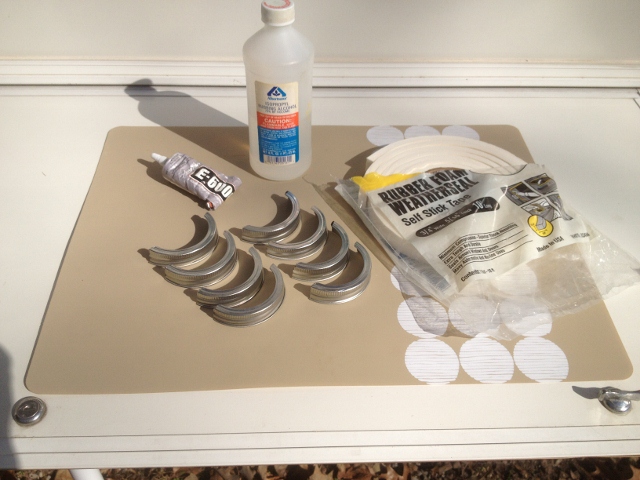
Exterior Cargo Bin Latches:  Horrible design.  To secure doors shut, these latches turn 90 degrees and catch behind a thin metal lip that sticks up about 1/2 inch.  The problem is that going down the road, if some piece of your cargo rattles up against the lip and pins the latch in place or blocks where it needs to turn to open, you are screwed!  No access to your cargo until you remove the whole door assembly.  Fixed that with some mason jar lid rings cut in half and edges smoothed with a dremmel, and glued to the cargo doors using E6000, such that they protect the latches as they turn.  So far they are holding up great!


I also ran some Rubber Foam Weatherseal Self Stick Tape (that I had lying around) along the bottom inside edge of the cargo bin to prevent anything pressing down along the bottom edge.  Of course I left a gap where the latches need to swing into place over the lip.  Cost:  $0.  Why can't those RV engineers eliminate this problem to begin with?

I still have more improvements in mind and will post them as I resolve them.  It's fun playing RV engineer, but extremely time consuming!

To see my earlier RV improvements, visit this page.  It is totally amazing to me how RV's are let out of the factory without these issues resolved! Just as amazing how each and every one of these problems can cost a fortune to resolve if you let the RV Repair people do them for you.  And they don't even have solutions for some of these problems!  We are pretty much on our own to resolve many issues.

Upwards and onward!